
A new poll last week confirmed the Democratic establishment’s fears that Michigan Senate nominee Abdul El-Sayed could hurt its hopes of winning the chamber’s majority.
The Fox News poll showed his personal image 13 points underwater among registered voters — 42% favorable to 55% unfavorable as he ran about even with his GOP opponent in a head-to-head matchup, trailing narrowly.
But while El-Sayed’s potential drag on the Democratic ticket has gotten lots of attention, he is very much the exception for the party.
In fact, it’s Republican candidates who have the popularity problem in a number of key races.
And of all the crucial Senate races, Michigan is the only one in which Democrats have the more unpopular candidate, according to averages of the quality polls available. In all the others, it’s the GOP.
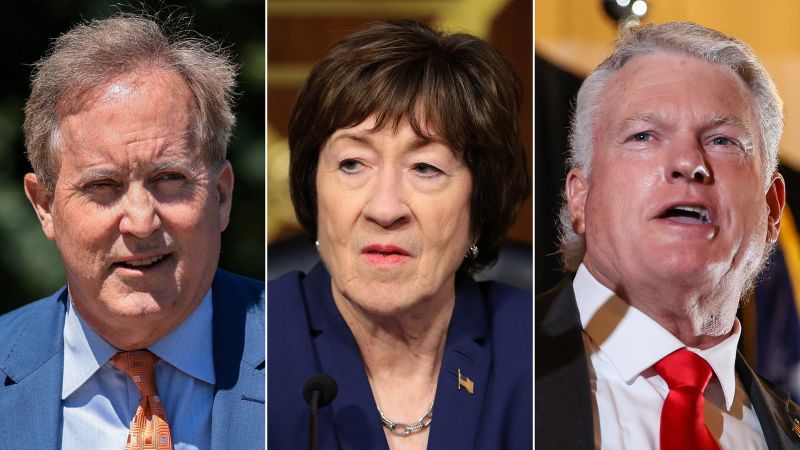
In both Maine and Texas, the averages of recent polls show both Sen. Susan Collins and state Attorney General Ken Paxton 12 points underwater — i.e., with more people viewing those Republicans unfavorably than favorably. That’s similar to where El-Sayed was in the Fox poll.
All told, across the eight races that are most likely to determine the Senate majority, the GOP standard-bearer has a net-positive average image rating in just one race — Alaska — while every Democratic candidate except El-Sayed is in positive territory.
And in seven of those eight races, the Democratic nominee polls more popularly by between 8 and 24 points.
The biggest gaps come in Georgia and Iowa, where both the Democratic nominees — Sen. Jon Ossoff and state Sen. Josh Turek — poll well. Each of their favorable ratings is at least 20 points better than their unfavorable ratings, on average. (In Turek’s case, he’s less well-known, but very few people seem to dislike him.)
Their GOP opponents — Reps. Mike Collins and Ashley Hinson, respectively — have middling personal image ratings.
Democrats also have a big edge in Texas, where state Rep. James Talarico is 5 points above water, compared with Paxton’s 12 points — a gap of 17 points.
In Maine, Democratic former state Senate President Troy Jackson is plus-3, for a 15-point gap in personal image ratings. And Collins’ minus-12 net image rating would seem a significant problem, given she’s a Republican running in a blue-leaning state. (Usually, the politicians who win in states that are unfriendly for their side tend to be broadly popular.)
Notably, about as many registered voters in Maine were “extremely” or “very” concerned that Collins voted with President Donald Trump too often (55%) in a Fox poll in that state as were “extremely” or “very” concerned that El-Sayed’s issue positions are too extreme (54%) in the Michigan Fox poll.
In North Carolina, Democratic former Gov. Roy Cooper is 14 points positive to former Republican National Committee Chairman Michael Whatley’s minus-1, which is a 15-point gap.
In Ohio, Democratic former Sen. Sherrod Brown is above water by 4 points, while appointed GOP Sen. Jon Husted is 5 points underwater — a 9-point gap.
In Alaska, Democratic former Rep. Mary Peltola is plus-9 to GOP Sen. Dan Sullivan’s plus-1 image rating — an 8-point gap.

And even in Michigan, El-Sayed isn’t the only one who’s unpopular. Republican former Rep. Mike Rogers is too — just less so, at minus-6 in the Fox poll.
Across the eight states, the Democratic nominee’s image is 8 points positive on average, while the Republican’s is 5 points negative. And that includes Michigan.
A big question is how much that’s a reflection of the candidates themselves versus the national environment. Voters are clearly frustrated with Trump, and that could filter down to the Republicans (like Susan Collins) who are viewed as his enablers.
But that explains only so much. The Democratic Party is not exactly popular right now — indeed, it’s about as unpopular as the GOP — and yet its nominees in some key races appear likable to voters. That suggests some solid recruiting and, in the cases of Turek and Talarico, shepherding of their candidates through competitive primaries.
It’s possible that Democrats will need El-Sayed to win to have a shot at the Senate majority; that’s how tough this year’s map is for the party. And that’s a big reason there has been such consternation about nominating him.
But it’s certainly not the full picture of the battle for the Senate.
