
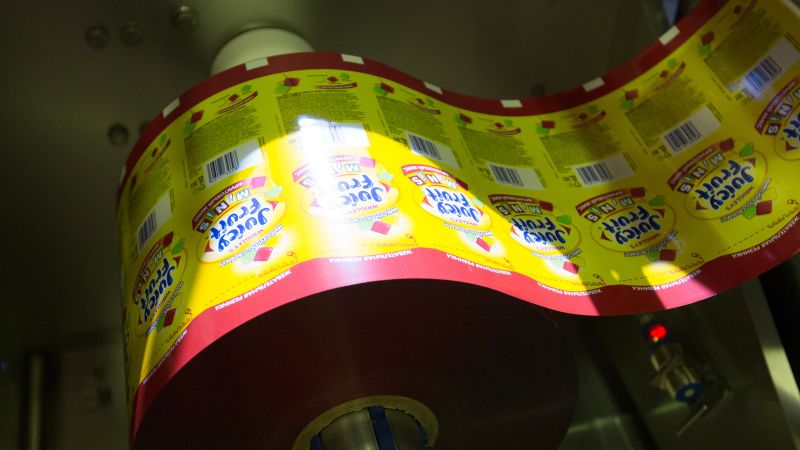
On June 26, 1974, a cashier at a Marsh supermarket in Troy, Ohio, scanned a pack of Wrigley’s Juicy Fruit gum and changed the way we buy things forever.
That first-ever barcode transaction brought stores into the computing age. Technology has obviously advanced a lot over the past 52 years, but the check-out process isn’t meaningfully different today: We use those same one-dimensional barcodes to ring up just about every product we buy at a store.
The retail and packaged goods industries decided it’s about time to give the reliable but outdated barcode an upgrade. Next year, we’ll start to see that next-generation barcode in action.
Replacing today’s one-dimensional UPC labels with two-dimensional QR-code-like alternatives could unlock some serious advantages for stores, manufacturers and consumers. Among them: It could help prevent the kind of outbreaks of deadly foodborne illnesses we’ve seen in recent months.
“I don’t think they’re overselling the benefits of this,” said Frank Yiannas, former FDA deputy commissioner of food policy & response.
Today’s 1D, 10-digit barcodes are really good at one thing: telling a computer which product is being scanned. And that’s about it. Once a product is sold, barcodes are effectively useless.
Two-dimensional barcodes contain up to 3,000 digits and characters, making them significantly more capable than their 52-year-old cousins. Cashiers can scan them at the register, just like 1D barcodes. But customers can scan the barcodes with a smartphone, too, directing them to a website with more information. And, crucially, 2D barcodes can deliver information about where and when the particular product was packaged.

That means scanning a 2D barcode can link you to an instruction manual, food allergens, coupons, show you what farm the product came from and whether the package is recyclable. Grocery stores can use the 2D codes to remove about-to-expire food and lock out spoiled items from getting rung up at checkout.
But the most tantalizing capability the new barcodes can unlock is the ability to radically change the way America performs food safety.
That’s why GS1, the New Jersey-based standards-setting body that oversees and licenses the world’s barcodes, believes the retail industry, manufacturers and consumers will benefit from the barcode upgrade — even if it takes some effort from stores and packaged goods companies to implement them.
Bin and lot numbers are crucial identifiers that let investigators, manufacturers, stores and customers trace a problem back to a particular batch of products. Today, those identification codes are printed on a product’s packaging, separate from the barcode. Usually, they include a string of indecipherable letters and numbers that look like they were stamped with a 1990s-era dot-matrix printer.
When a product is recalled, a human being — an inspector, a store associate or a customer — needs to decipher the bin and lot number to determine whether a product is safe or dangerous. With 50,000 unique items for sale and dozens of each on shelves at your typical big box store, that’s a lot for human beings to keep track of.
“Human systems aren’t infallible,” said Yiannas, who served as Walmart’s head of food safety for 10 years. “It’ll no longer be a guesstimate. Precise recalls would add a lot of value to companies and to the customer.”
An enormous amount of safe food gets taken off shelves and is wasted under the current system, costing big retailers hundreds of millions — and in some extraordinary cases, billions — of dollars each year, according to Yiannas.
That waste, of course, represents the best-case scenario. At worst, people can lose their lives, as two have in this summer’s cyclosporiasis outbreak.
Two-dimensional barcodes possess the capability of helping to change that: Packaged goods companies can write bin and lot numbers directly into the barcode to trace recalled items and warn stores and customers about them.

Ideally, that technology would prevent potentially dangerous items from hitting shelves in the first place. If they make it to the shelves, manufacturers and stores could stop recalled items from scanning. And if they get to a customer’s home, consumers can scan the code to determine if the product they purchased is safe.
But we’re not there yet. We’re not even particularly close.
To get bin and lot numbers baked into 2D barcodes, a unique label may need to be printed on site, or packages with those identifiers would need to be pre-printed and shipped to particular locations. That’s very different than today, where most packages are uniform, filled, and then bin and lot numbers are affixed afterward.
It’s a complication in the packaging process that is necessary to effect change — but may not be easily overcome.
Some are skeptical that this is a realistic option.
“Barcodes could be an extremely valuable tool to help food companies track lot codes,” said Thomas Gremillion. “But without any regulation in effect, there’s not a lot of incentive to invest in this technology.”
Yiannas disagrees: The amount of money needed to invest in the new 2D barcode and packaging technology is meaningful — but not compared to the cost to a company’s bottom line when things go wrong.
“Printing it on something like a soda can may not be technologically feasible right now, but a gallon of milk should be,” Yiannas said. “You may have to change a little hardware, but the value proposition is huge. Losses at Walmart from recalls can be catastrophic.”
Even if the industry ultimately decides to adopt that promising capability, it’s not going to be implemented quickly.
GS1 started work on a new 2D barcode variant in 2017 with an aim to roll it out in 2023. The retail and packaged goods industries, which helped form GS1 in 1973, told the nonprofit it would need more time.
So GS1 adopted a slower approach, guiding the industry to start rolling out the new 2D barcodes alongside 1D UPCs next year as part of its “Sunrise 2027” initiative.

CNN 5 Things
One Thing: Did Trump Cuts Slow the Cyclospora Outbreak Response?
This summer, a massive cyclospora outbreak and multiple major salmonella-related recalls have some Americans worried about getting sick and reconsidering whether to buy certain foods. Is there something wrong with our food safety apparatus? And did Trump administration cuts to the CDC and FDA have anything to do with it?
Aug 16, 2026 • 27 min
“Moving an entire industry takes a long time,” said Melanie Nuce-Hilton, senior vice president of customer success at GS1. “Right now, we’re focused on ensuring checkout isn’t disrupted. It has to beep. That’s very important to a retailer.”
That ability is probably there for just about every retailer, even the tiniest ones, according to Linda Toth, executive director of Conexxus, an industry technology group that supports convenience stores and gas stations. Some are nervous about the transition, but Toth says her group is working to educate stores that they may need only minor and inexpensive upgrades to enable it.
“Many retailers are ready for this. They just don’t realize it,” said Toth. “Really, what we’re waiting for is for products with 2D barcodes on them.”
They’re already starting to show up: Topo Chico seltzers and Procter & Gamble products are early adopters and already displaying 2D barcodes in addition to the 1D codes. Consumer Brands Association, a packaged goods trade group, has launched the “SmartLabel” tool to allow consumers to scan 2D barcodes and view product information in the same format across multiple brands.
But it won’t all happen overnight. Rishi Banarjee, senior director of SmartLabel, noted it took about 10 years for the industry to fully adopt the original barcode after it launched.
“I don’t think this will be a 10-year transition,” said Banarjee. “We expect it to start to ramp up as more retailers come online.”
