
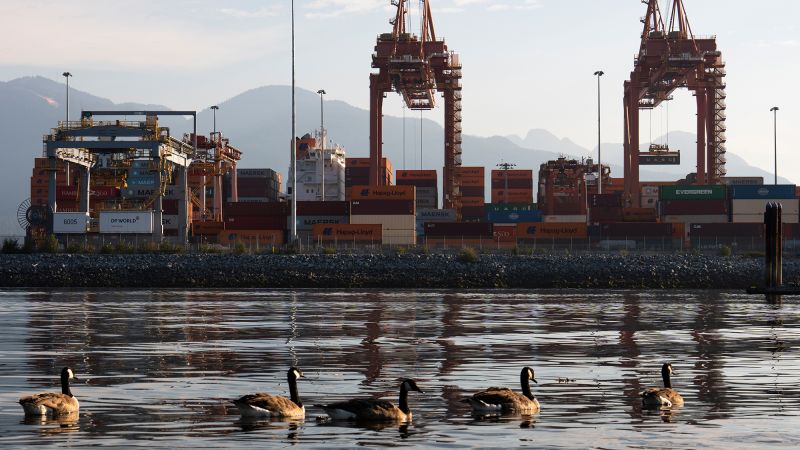
Less than two hours before yet another midnight tariff deadline, President Donald Trump backed off late Tuesday from his threat to impose steep tariffs on Canadian goods.
The two nations struck a deal, Trump announced, with few details. “We’re going to give something, and we’re doing certain things,” he told reporters Wednesday.
The 11th-hour pivot underscores how the Trump administration has used tariffs not only as an economic tool, but also as leverage in negotiations with allies and adversaries.
The spat over tariffs isn’t really about taxing $20 billion of Canadian imports. It’s about whether Trump can use the threat of levies to extract concessions from America’s closest trading partner — including, but certainly not limited to, opening its markets to US farmers and offering more favorable terms for US businesses.
For example, days before announcing the pending tariff threat, Trump said he was considering levies to punish the United States’ northern neighbor for allegedly not doing enough to stop wildfire smoke from polluting American air. Now, Trump claims to have used the threat to revive the Keystone XL pipeline.
After the Supreme Court overturned Trump’s most sweeping tariffs earlier this year, igniting a multibillion-dollar refund process, businesses got a reprieve from a near-constant dizzying tariff cycle over the previous year. It even gave many employers the confidence to expand their workforces, something they had avoided to ensure they had the cash on hand to pay for tariffs.
But it wasn’t long before Trump made headlines threatening 50% levies on $20 billion worth of Canadian goods – this time with a never-before-used trade law bringing the country back into Trump’s tariff crosshairs.
Trump’s pitch for tariffs is rooted in his belief that the global free trade push for most of the post-World War II era is fundamentally flawed. “To me, the most beautiful word in the dictionary is tariff,” he said on the campaign trail in 2024.
Trump sold tariffs to voters as a kind of cure-all: They would restore America’s manufacturing sector, bring foreign nations to heel and bring in mountains of revenue, he said.
While tariffs can do some of those things in theory, they cannot accomplish all three at once. If tariffs are an effective cudgel in a diplomatic dispute, they pretty quickly lose their power to bring in revenue or convince business leaders to invest in reshoring.

For instance, Trump’s stated rationale for enacting new tariffs on China last year was to curb the flow of fentanyl to the US. What started as a 10% minimum duty on Chinese goods skyrocketed to well over 100%. China hit the US back with similarly scorching tariffs.
Trade between the two nations came to a standstill, preventing the tariff revenue windfall Trump had predicted. It’s difficult to say how effective the tariffs were at curbing fentanyl trafficking; China remains a major source of the precursor chemicals Mexican cartels use to make the drug, according to the Drug Enforcement Administration.
Trump’s promised “golden age” of manufacturing also hasn’t arrived. The White House has eagerly taken credit for the modest rebound in manufacturing jobs this year, with some 31,000 new positions added since January. But the economy has lost around 62,000 manufacturing jobs on net since the beginning of Trump’s second term. It’s not clear how big a role tariffs have played in the recent rebound.
The winners and the losers
Like any economic policy, tariffs won’t benefit all parties. They became popular in the 1800s as a form of economic protection, buying nascent American businesses more time to compete with well-established manufacturers across the pond.
Today, there are plenty of American businesses that benefit from Trump’s aggressive trade playbook.
Among them: Cleveland-Cliffs, one of the largest American steel manufacturers, has been able to charge customers markedly higher prices compared to around a year ago, before Trump introduced 50% duties.
“This improving situation in both steel and automotive demand can be attributed to the long-overdue trade policies we now have in place in the United States,” CEO Lourenco Goncalves said on an earnings call last month.
The tariffs, he added, have been “the single most effective industrial policy implemented in our country in a generation.”

But the extra money their customers are paying for American-produced metals could very well be taken from a pot of money used to pay worker bonuses, make 401(k) contributions, or hire more workers. The tariffs amounted to an average tax increase of $1,000 per household in 2025, according to the non-partisan Tax Foundation.
Now, as part of the agreement Trump is finalizing with Canadian Prime Minister Mark Carney, duties on Canadian steel, aluminum and cars could be coming down. The average American who isn’t connected to those industries isn’t likely to feel any immediate change – for better or worse.
But they’ll keep paying a premium that companies have baked into pricing, because the only thing that continues to be certain on the trade front is uncertainty.
