
Phil Steele is stumped. A man who spits out information for a living, who can recite chapter and verse on the offensive line at UMass, has no answer to an innocuous ice breaker of a question.
He hems and haws for a few seconds before he finally gives up, admitting that he not only doesn’t have a favorite TV show; he can’t really name any.
“I check the weather. I watch the news first thing in the morning,” he tells CNN Sports. “If my daughter wants to watch a movie, I’ll watch a movie.”
Because, of course, Phil Steele doesn’t have time to binge-watch some Netflix or Hulu nonsense. He’s too busy consuming his daily dose of pigskin. The author of the veritable college football Bible – the eponymous “College Football Preview” – Steele long ago ditched such banalities as hobbies and pastimes.
He watches college football. He rewatches college football. He takes notes on college football. He talks to coaches about college football. He writes about college football. He edits what he’s written about college football. He publishes a magazine about college football.
Every year for the past 32 years, this is his livelihood and his life, his devotion to his craft so singular that only last summer did he finally see Europe for the first time. In return, Steele has carved a unique and profitable niche in the oversaturated American sports landscape by providing the two things fans crave most: information about their teams and the chance to sound smart.
His is one of the few publications where the tagline – The Book Experts Cannot Do Without – isn’t hyperbole. Reporters and athletic administrators are among his most devoted buyers and coaches happily take his calls each year.
The magazine’s arrival each year evokes the same giddiness kids once experienced when the Sears catalog popped in the mailbox around Christmas time, largely because it delivers the same sort of promise.
College football can’t be far away.
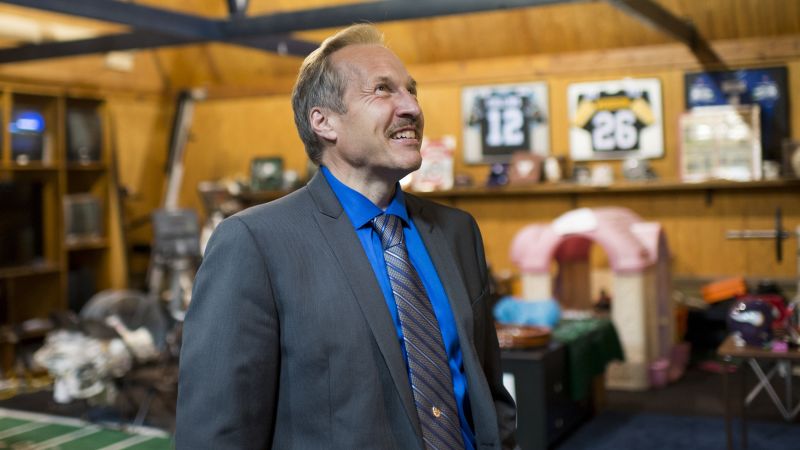
In 1992, Steele bought a six-acre property from the former wrestling coach at Saint Edward’s High School. The coach intended to use the barn as a wrestling room for his players. Steele has turned it into his rec room.
There’s a trampoline, bikes and a full basketball court. Every day, along with hopping on his Peloton and ensuring he reaches his 15,000-step allotment, the proud papa of pigskin prognostications … hoops.
It’s about the only time Steele isn’t watching or thinking or writing about football.
“College football,” he says, “is all I do. It’s my world.”

He came by his passion for pigskin honestly, through the pure-eyed adoration of childhood. Born in Cleveland, he rooted for his NFL (Browns) and college (Ohio State) hometown heroes, ravenously devouring the daily newspaper for information on his teams.
His devotion changed when his father, Henry, introduced him to parlay cards – the pencil and paper betting sheets where picking multiple winners meant a nice little payout. A self-avowed math guy – “Don’t ask me about art,” he says. “I can’t even draw a stick figure” – Steele loved the challenge of studying and picking the winners in exchange for a few bucks.
By 10, he was picking a steady stream of winners and crafting power rankings for his own enjoyment.
Steele tried college, but nothing academic suited him quite like his love for football. At 21, he decided to bet on himself, quite literally, starting his own handicapping service.
As Steele nuanced his skills, the service begat a newsletter – “Power Sweep” – crafted after his parents took out a second mortgage so he could buy a print shop. The first seven years he hemorrhaged money, his picks not nearly good enough to earn him a salary. Steele slept in the print shop, unsure what to do next. And then in 1989, the same year his father died of cancer, Steele went 53-23, the roll continuing through the next season.
His handicapping merited attention and newsletter sales, but Steele soon tired of tipping his own hand to the oddsmakers in Vegas.
“My underdog pick would start as a seven-point underdog, but then I’d put the information out and they’d be a four-point favorite,” he tells CNN Sports. “My picks lost value.”
By the mid 1990s, the magazine section of the local bookstores and pharmacies were stuffed with football preview issues. Street & Smith’s was the originator, printing its first preview yearbook in 1940, but as the sport exploded, so did the market. Sporting News, Athlon and Lindy’s all crafted similar mags. Steele perused them on the regular, looking to pad his newsletter. Instead, he felt like he had more than they offered.
The first “Phil Steele College Football Preview” was born in 1994. With 195 pages printed on black-and-white newsprint, it looked more like a beefed-up Daily Racing Form than a slick publication.
Steele mailed it out to radio stations across the country, hoping they’d make a mention on air.
“I had no idea what I was getting into,” he says. “Pretty soon, people needed the magazine. We stopped giving it out for free.”
The most recent issue of the magazine is a robust 375 pages and includes the same dense two-page spread for the Texas-San Antonio Roadrunners as it does for the Texas Longhorns. Every single FBS team – all 138 – is covered.
It is not, by any stretch, literature, nor does it follow any sort of editorial style. Capitalizations show up at their leisure (Offense, Defense and Forecast) and some sentences require translation – Baylor 3-2 ATS L/5 vs FCS/under hit 3 str., for example. For spacing purposes, Steele has removed the following words – left, at, by, went, had, in, the, to, for, and, then and got – and has crafted his own abbreviations. DNR, in Steele’s case, is far less dire; it merely means a player did not return.
The author – though Steele has a staff of around 10, he writes every word in every single two-page spread on every single team – makes no apologies. This is not a publication meant to meander through; it exists to provide information.

There is an entire page devoted to NCAA experience, with an explanation of his formula used to rank teams and a two-page spread to cover the results of every single bowl game for the last 10 years. On the team pages, there are paragraphs devoted to every position, forecasts for both sides of the ball, nuggets to help set the stage for each game, and the past five years’ results, complete with the line.
Not to mention predictions for the country’s top individual units, surprise teams (last year, it was Oklahoma, which went from 6-7 to the playoff; this year, it’s Alabama) and most importantly, his preseason top 40 and conference orders of finish.
“My goal is to be graded as the most accurate magazine,” Steele said. “And I should be. Nobody puts the time into it that I do.”
He is not exaggerating. Steele is a man of routine and excess preparation. He wakes each morning at 5:45, hops on his Peloton and watches one of two things – either an old game on tape or a replay of SportsCenter. If it’s the latter, he condenses the show into minutes, skipping through anything that doesn’t have to do with college football.
After that, he heads to his office. On a college football Saturday, he will arrive by 7 in the morning and by noon has his bank of TVs cued up, 12 games running simultaneously. He’ll do the same for the 4 p.m. kickoffs before heading home for the night games, where he cuts back. Steele only watches eight games at once then. He gets by on a steady diet of caffeine, his self-deprecating “see-food” diet (“If I see it, I eat it,” he says) and an obsessive addiction to college football.
It is impossible to see every play of every game, but the downtime in between allows Steele to scan back and forth.
He takes copious notes on what he sees, crafting notebooks full of information and also creates and tracks nine sets of power rankings on a computer spreadsheet that, to the untrained eye, looks like color-coded gibberish. To Steele, it makes perfect sense.
The portal has made his work harder, not just in terms of gathering information but getting a handle on whether a roster will and won’t mesh, but if he has a pet peeve, it’s the revolving closet of uniforms.
“Sometimes, it takes me until halfway through the first quarter to figure out who someone is,” he said.
When the games stop, Steele continues. During the course of the season, he has a service that provides every article written about every team and when there are no longer games to watch, he reads. He’s looking for trends and progressions at various positions, subtle shifts he might otherwise miss in his game watching. Some schools might generate only a handful of print; a team like Ohio State, on the other hand, produces its own anthology.
In the spring, he starts calling around to coaches. As the magazine’s popularity grew, so, too, did Steele’s reputation. Conferences started to invite him to speak at their media days, where he earned introductions to the men who headed up the teams he wrote about. For this year’s issue, Steele spoke to 133 of the 138 teams featured.
It all coalesces through three edits and iterations into the one-of-a-kind magazine that comes out in July.
Or Steele thought it was one of a kind. This year, a customer called Steele’s office to complain about the smaller book he purchased online. “We don’t have a smaller book, for crying out loud,” Steele says.
A quick search revealed the culprit: Four fakes for sale on Amazon. A furious Steele posted a lengthy buyer beware warning on both his website and X, apoplectic that someone would steal his name and minimize his life’s work.
Told that imitation is the highest form of flattery, Steele guffaws.
“Not in this case,” he says. “They put my name on an inferior product.”
The irony is not lost on Steele that what began as a passion project has, in some ways, altered his passion. Though his daughter is a nursing student at Ohio State, Steele is no longer a Buckeye devotee. His definition of a favorite team is the underdog he picked higher than everyone else.
And while he devours more college football than ever before, the kid who once watched wide-eyed at his heroes can no longer watch a game without a clinical, detached assessment.
“I’ll be in the barn watching UL-Monroe against Georgia State and I’m thinking about next year’s magazine,” he says. “Like how does the offensive line look?”
But it does get him thinking, back to the original icebreaker question. Steele does, he realizes, watch a little TV for entertainment.
“I like to watch FCS football,” he says. “I have nothing on it. Don’t have to make a pick. I can just sit back and watch.”
