
Hengdian, China
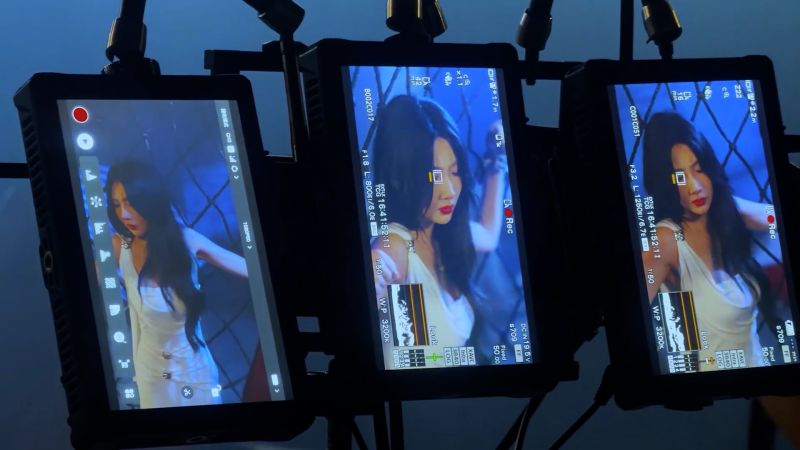
Everything seemed to be business as usual as filming got underway on a dimly lit set in a basement in Hengdian, a town nicknamed “China’s Hollywood” for its sprawling complex of film studios.
Cameramen raced around hectically setting up lights and checking shots as choreographers ran through fight sequences and a prop team worked out how to hoist a net that would later restrain a hostage.
Actors, most dressed as assassins and hitmen, milled about or squatted, smoking cigarettes and getting occasional touch-ups from roving hair stylists and make-up artists as they waited for their scene to start.
But behind the bustle was a new reality: while just a few months ago, production of these so-called “microdramas” was flourishing in Hengdian and other hubs – today, these sets are falling quiet.
Seemingly overnight, new AI-video generation tools have taken over the microdrama industry, able to produce these popular, vertical shows at a fraction of the cost, decimating the number of live-action productions across the country and flooding platforms with AI-made content. More than 120,000 microdramas were released in the first three months of this year — with 95% of those generated by AI, according to Chinese state media.
That’s made the industry one of the most visible examples of how China’s breakneck AI transformation is impacting people’s livelihoods — wiping out jobs and creating new ones, leaving everyone unsure what’s next. It’s the kind of technological disruption that many creatives fear could upend movie-making far beyond China.
Between takes actor Junlin, who asked to be identified by her stage name, talks about how she’s struggling to stay afloat as a “bitter winter” has arrived for productions like hers.
“With fewer productions hiring, your space for survival is constantly squeezed,” said the 24-year-old, dressed in combat boots and a high ponytail to play a head assassin who storms around with a posse of hitmen in an upcoming microdrama.
She’d worked only seven days in June, a sharp fall from the spring when she’d been filming 25 out of about 30 days per month in Hengdian and other cities. “I’m someone who gets anxious easily,” she said. “If I’m not on set, I would be in a constant state of anxiety.”
Hengdian, a town of just over 200,000 tucked in a rural part of eastern China’s Zhejiang province, had been booming with the rise of the microdrama industry in recent years.
Broken into roughly 90-second episodes, microdramas first emerged during the pandemic, capitalizing on the popularity of short video apps like Douyin and Kuaishou as cinemas and studios closed.
While each episode is designed to be quick to consume on a mobile phone, together the clips weave together plotlines that can stretch the length of a feature film.
These microdramas — and their often soapy or outlandish plots about wicked mother-in-laws, mistaken identities, wartime heroics and wronged lovers — have since proliferated in China and spread to audiences overseas, where they’ve spawned a fast-growing, multi-billion-dollar industry.
They’ve also caught the attention of China’s censors, who are tightening oversight of microdramas with new rules set to take effect in September. Plotlines, for example, will need to “adhere to correct political direction.”
Last year, the domestic microdrama industry was valued at nearly $15 billion, according to market research firm DataEye, almost double the market size for box-office feature films in the country. Its rise ushered in a welcome heyday for young creatives at a time of high youth unemployment in China.
“Once microdramas took off, there was a nonstop stream of roles I could take on as long as I wanted to film,” said Bi Zhiqiang, 27, another actor living in Hengdian, who quickly built a career after moving there in 2021 as the industry was taking shape.
“Many people who didn’t even study acting or film and television joined because there were more and more opportunities.”
The lure drew thousands of crews to Hengdian last year to shoot projects in and around the sprawling Hengdian World Studios.
It was a fresh injection of energy for the town and its decades-old eponymous studio, known for its large-scale replicas of some of China’s iconic imperial architecture, like the Summer Palace and the Forbidden City, and for birthing Chinese blockbusters.
Other hubs — like Qingdao, Xi’an, and Zhengzhou — emerged across the country, too, with microdrama crews shooting in expressly built complexes with fake mansions, boardrooms, and ERs.

But the industry quickly became a pressure cooker for actors and production crews, due to a hyper-competitive model built around cranking out as many microdramas as possible in the hopes that one would go viral.
Actors and crew describe standard 18 to 20-hour working days as productions rushed to stay within budget while shooting what are essentially feature-length movies in the space of roughly a week.
“As long as they keep filming, they can keep releasing. And the logic is — there will always be one that becomes a hit,” said Guo Ertai, a director and actor at the National Theater of China in Beijing, who followed audiences and money into the microdrama industry several years ago.
At the bottom of the pecking order are extras, who might work long shifts for as little as 10 Chinese yuan ($1.50) per hour, a wage one former actor commented wryly was less than the rental rate for some of the animals used in productions.
Even still, the allure of success kept the industry flush with young, ambitious actors, directors and creatives.

Unlike film, which has a high barrier to entry, microdramas “gave an ordinary person an opportunity,” said Guo, the director. The thinking is “‘I can become rich overnight, I can become a star overnight, I can earn a lot of money overnight with very little outlay,’” he said.
Microdrama actors have become celebrities in their own right with millions of followers on social media platforms. Some television and film stars — including martial arts legend Jet Li — have starred in microdramas. Even those without broad name recognition, who were able to land leading roles in successful dramas, could make multiples of an average monthly urban wage.
But as more money and bigger names entered, competition grew fiercer, pushing a drive to export the dramas overseas for more revenue — and use whatever means available to cut costs.
It took a few weeks for actor Zhuang Wenjie, 28, to realize something was wrong when she returned to Hengdian after celebrating the Chinese New Year holiday in her hometown in February.
She had moved to the area last summer and felt she was just beginning to make a name for herself and could start auditioning for higher profile roles.


At first, she didn’t quite connect the empty streets around her with the growing number of AI-generated microdramas she saw on her social media feeds.
Soon, though, it became obvious: people weren’t returning because jobs had dried up. “Suddenly (there was) a feeling of impending crisis,” Zhuang said.
ByteDance’s SeeDance 2.0 had arrived.
Seemingly overnight, Chinese social media was swamped with realistic-looking, AI-generated videos, as users played around with the new, powerful video generation tool.
And when it came to microdramas, SeeDance 2.0 was well positioned. ByteDance owns two of the main platforms in China that host microdramas: Douyin, Tiktok’s sister app, and Hongguo. It also has a repository of novels that make up a well of copyrighted material for scripts that collaborating production teams can draw from.
Other tech firms have released rival video-generating technology in recent months, including another short video app owner Kuaishuo, tech giant Alibaba and AI firm MiniMax.

Using next-gen AI video tools, a 120-minute project of ordinary quality can take a five-member team roughly a week to produce and cost some 15,000 yuan, about $2,200, one production firm told CNN — less than a tenth of what’s typically cited as the low-end cost of a live production.
In the first half of the year on Douyin alone, 220,000 new AI-generated microdramas racked up a staggering 500 billion views, according to DataEye, the market research firm. Some were animations, but more than half since March used AI that simulated real people.
Zhuang decided to leave town in April, joining an exodus of actors and crew from the area. “The number of jobs in Hengdian was decreasing day by day, and the pay was also getting lower and lower every day … the hardship really did defeat me,” she said.
Actors who did stay on described cratering salaries, such as being offered 300 yuan (about $45) a day to play the kind of leading role that would have previously paid thousands. Some have turned to side jobs to make ends meet.
Liu Yuzhan, 29, says he’d been making steady money booking four new roles a month in the past couple years. Now, Liu says he’s picking up extra work as a food delivery driver.
“I have my own mortgage and I’m responsible for my parents’ retirement. Given the current market of microdramas… it’s simply not enough to cover my daily expenses,” he said.
As AI tools put microdrama actors out of work, social media chat groups that used to advertise acting opportunities were swamped with a different kind of classified: for AI editors, programmers, designers and screenwriters. And a new crop of companies, editors and entrepreneurs have poured into the space.
Among them is Tan Chen, a 21-year-old college student who founded a startup that began focusing on AI production in April.
His team, which is based in Jinan, a provincial capital in eastern China, takes scripts or novels, and “optimizes” them for microdramas by crunching down the narratives and ramping up the excitement and suspense. They decide the look of the characters and the set, a process Tan describes as “similar to casting and location scouting,” and then build a storyboard.
“We need to transform what we see in words into something that can be expressed visually. That really tests our production staff’s directorial thinking and audiovisual language abilities,” he said.
How well the AI images come together depends on that language. Employees known as “card-pullers” must use prompts — typically written with the help of AI — to repeatedly generate AI video clips until they get ones that best convey the scene, which are then edited together.
When his team started, Tan said clients would pay them 1,000 yuan, about $150, a minute, typically for a 120-minute project.
But just like actors and live production crews, these creatives are also feeling the squeeze.
A crush of programmers joined the industry and middlemen taking a cut to link creators with clients have multiplied, driving down profits for teams like Tan’s. He’s now fielding projects for as low as 150 yuan per minute — around $20.
“This rapidly growing market inevitably has a certain degree of bubble,” he said.
His company also recently switched to making AI-generated cartoons to avoid inadvertently using AI images that draw from real actor’s faces.
The use of AI characters that resemble real-life actors, without permission, has become a key issue in the industry — with at least one case of a well-known actor receiving court-ordered compensation, state media reports.
But other actors, aren’t so lucky.
Actor Yu Shutian, 31, recently found what she believes was her own face “blended into AI,” after fans alerted her to an AI-generated character that resembled her.
She knew it was nearly impossible to prove the likeness was based on her face, so she never pursued legal action. She also says she realized it was probably the technology, not the creator who was responsible.
“AI is unstoppable. If you can’t beat it, join it, so I’d rather find a reasonable way to embrace AI,” said Yu, who is starting to use the tech as she’s moved some of her focus to directing.

Yu Shutian appears in her self-produced microdrama.
Yu Shutian appears in her self-produced microdrama.

That sentiment illustrates a central tension raised by many of the actors who shared their stories with CNN.
While AI may render the miles of studio space and life-sized sets of places like Hengdian unnecessary, what role humans — including actors — ultimately play in the industry, working alongside AI to create art and entertainment, is far from settled, they say.
Microdrama streaming app Hongguo in recent weeks raised production standards around AI-generated dramas, and ratings in recent weeks suggest there’s still viewer appetite for “real people dramas,” which rank in the platform’s top 10 alongside AI productions and cartoons.
“AI is formulaic — it can’t express the full range of human emotions and desires,” said Junlin, the actor who is staying put, for now, in Hengdian. “How could it possibly replace humans?”
But when it comes to the transformation underway in her industry, she sees the newer actors like herself, who are still trying to make it, as the most vulnerable.
“AI absolutely can’t replace a real person,” she said. “But it might be able to replace me.”
