
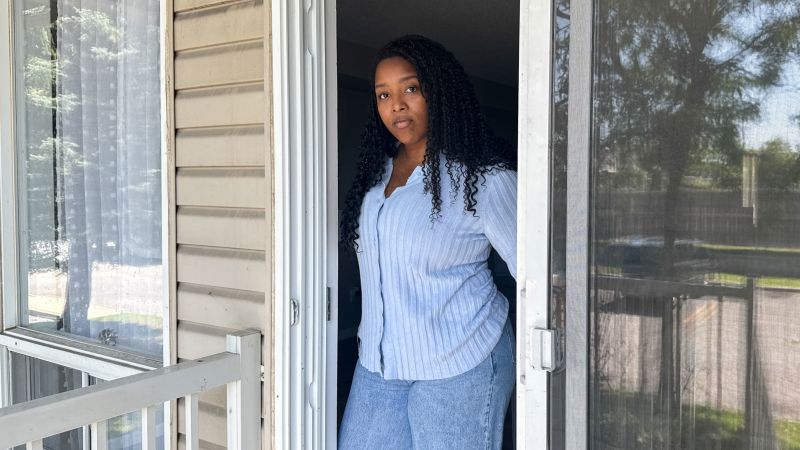
Gemima Cadet took one last look around her room in Lake Worth, Florida.
She’d already given away paintings that she’d poured her heart into, and books she loved to read. But even in a vacant room with empty hangers dangling in the closet, there was still one thing left that she loved and wanted to remember: the light.
Living in Florida for more than half her life, the 32-year-old had come to know it well. The way the sun streamed through her window gave her strength on many a difficult day.
And this would be a difficult day.
Cadet and her mom were leaving their home and heading north toward an uncertain future.
It was a journey many Haitians like Cadet have made. During the first Trump administration, a road from upstate New York to Montreal became a well-known crossing point. But since then, the rules have changed significantly, and it’s much harder to make asylum claims at Canada’s border. Still, some are trying — including Haitians whose deportation protections in the US have been revoked.
“Some people … knowing fully well all the risks and all the troubles, they’re like, ‘I will give it a shot, and I will try, because I have nothing else, and I cannot go back to Haiti,’” says Fedora Mathieu, an immigration and refugee lawyer in Ottawa, Canada’s capital, whose office has fielded a growing number of calls from Haitians in the US.
For Cadet, on the day she left her Florida home back in January, it felt like she had no other choice. There had been so many ups and downs since the Trump administration first announced it was ending deportation protections for Haitians, she says, and the endless uncertainty was suffocating.
Returning to Haiti would be too dangerous, she says, and staying in the US was beginning to feel that way, too.
Some friends suggested she should wait. But Cadet found herself wondering, “How much longer do you want me to put my life on hold?”
Thierry Jean-Baptiste has been getting frantic calls for weeks from people in the US asking for help.
The recent US Supreme Court decision that cleared the way for the Trump administration to end deportation protections for hundreds of thousands of Haitians left many looking for options and unsure of where to turn.
“They’re worried. They’re stressed,” says Jean-Baptiste, coordinator of immigration and integration at the Montreal Haitian Community Office. “This is a nightmare for them.”
Major immigration raids focusing on Haitians in the US haven’t been reported. But advocates say they’re seeing an uptick in arrests, and fear is running high in communities across the US. The first deportation flight since TPS ended landed in Haiti last week with more than 160 passengers onboard, and authorities have said more flights are expected.


Many don’t think it’s safe to return to Haiti, where the UN has said violent gangs control vast swaths of the country. But when the second Trump administration announced plans to end Temporary Protected Status, or TPS, for Haitians last year, officials argued conditions in the Caribbean nation no longer warranted an extension of the protections.
“For too long, TPS has been allowed to function as a de facto amnesty program despite Congress never intending it to be permanent,” a Department of Homeland Security spokesperson said in a recent statement to CNN.
And experts say many Haitians hoping for a more sympathetic reception from Canada are learning that heading north is harder than it sounds.
The rules at the Canada-US border have tightened significantly in recent years amid pressures including shifting public opinion. A revised Safe Third Country Agreement between the two nations announced in 2023 requires immigrants to seek asylum in the first country where they arrive, and denies eligibility to those who’ve crossed illegally between ports of entry.

Only some qualify for exceptions to the asylum restrictions, such as those who have close family members already living legally in Canada. In addition, a law creating new asylum eligibility requirements, including new time limits for applying, went into effect earlier this year.
“Coming to Canada is a narrow path for a small group of people who do meet an exception,” says Jenn McIntyre, clinic coordinator of the Canada-US Border Rights Clinic.
And the risks are significant for those who don’t qualify but try to cross anyway, she says.
“The consequences are not just being not let into Canada,” she says, adding that those who are returned to the US will likely then be detained and deported. “So, the stakes are really, really high.”
It wasn’t the first time Cadet had fled a country.
She says she came to the US on a visitor’s visa with her family after the 2010 earthquake. At that time, she thought it would just be a brief stay.
“I was 15-ish, and fully, like, in my head, expecting to go back to Haiti in a couple months, to come back and see my friends, see everything how I left it. … I didn’t even understand that I would never see my room again,” she says.
As conditions in Haiti worsened, Cadet ended up graduating from high school and college in the US. Recently, she’d been working as a developmental specialist, traveling to day care centers and homes across South Florida to work with children, while also studying towards a master’s degree in social work and helping to run a mental health nonprofit she co-founded.
The place she’d never expected to stay had become her home. And deciding to leave it felt different from her family’s rushed departure from Haiti.
For a month, she debated whether it was the right decision. Once she and her mom resolved to go, Cadet had goodbye dinners and gave away paintings she’d made during the pandemic, beloved books and Renaissance fair costumes to friends who she knew would love them as much as she did.


She took a mental picture of the light streaming through the window of her room before she left. And as she and her mom headed north, she snapped photos on her phone of their journey — her mom looking somber at a rest stop, the last Florida sign as they were leaving the state.
For most of their two-day drive, Cadet was on edge. Videos were spreading on social media of immigration crackdowns in Minneapolis and other US cities.
“It was stressful to think that we might accidentally drive into one of those situations, or end up in a hotel and wake up, and then all of a sudden ICE officers were in the same building,” she says.
As they waited in a Buffalo hotel room, she worried US immigration authorities could be in the area. It was still dark when they headed toward the border at 7 a.m.
Haitians top the list of nationalities requesting asylum at ports of entry along the Canada-US border, according to the Canada Border Services Agency.
But so far this year, refugee claims at that border are significantly lower than they were last year, according to Kelly Cameron, a spokesperson for the agency.
As of August 9, the CBSA had processed nearly 9,000 asylum applications so far this calendar year, more than 60% less than the number of applications processed at the same point last year.
And since January, nearly 900 asylum claimants have been sent back to the US after being deemed ineligible under the Safe Third Country Agreement between the two nations, Cameron said.
On its website tracking immigration trends, Canada’s government touts the steps it’s taken to “minimize unnecessary border volumes, increase information sharing, and reduce non-genuine visitors and crossings between ports of entry.”
Immigrant and human rights advocates have been pushing Canadian officials to reconsider their approach. Amnesty International argued in a recent court challenge that it’s unconstitutional to send “at-risk refugees back to danger in the U.S.”
A spokesperson for Immigration, Refugees and Citizenship Canada said the department cannot comment on pending litigation or speculate on future policy decisions.
“Canada has a proud humanitarian tradition and takes its international obligations regarding asylum seekers seriously,” Anahita Beladi said, noting that the Safe Third Country Agreement remains in place.
Sometimes, says McIntyre of the Canada-US Border Rights Clinic, even people in the same family can face different fates under the current system, depending on factors like whether they’ve previously applied for asylum in the US and who their so-called “anchor relatives” are in Canada.
“That’s one of the hardest conversations that we regularly have with people,” she says, “letting them know that some members of the family will be eligible to enter Canada and seek protection, and others will not.”
Arriving at the Canadian border was nerve-wracking, Cadet says, even though she’d researched the process, gone to an official port of entry and brought documentation showing she and her mom had close family members living in Ottawa.
But something instantly struck Cadet about the border authorities who processed their paperwork.
“They weren’t rolling out a red carpet or anything, or giving us special treatment, but they treated us like humans. They talked to us, and they asked for the documents and looked them over, asked us questions, but didn’t treat us as if we were criminals,” she recalls.
After about three hours, the mother and daughter were on their way to Ottawa to reunite with family together.
A few months later, Canada’s asylum rules tightened. And Cadet says she knows other Haitians in the US who now want to go to Canada but can’t find a legal pathway.

She’s relieved she and her mom made it across the border. But she says seven months after arriving in Canada, they’re still adjusting — and waiting for a decision in their asylum case.
Her mom is trying to transfer the nursing license from Florida that will allow her work in Canada. And she struggles with regrets about leaving friends and patients behind.
Cadet misses living just 10 minutes from the beach. It’s hard being so far away from the community she helped build in Florida. And it’s devastating to talk with friends in the US who are struggling with the same fear and uncertainty she fled.
But Cadet has landed a communications job, and she hopes to start an internship soon that will help her finish her graduate degree in social work. Some of her friends from Florida recently came to visit. A few brought back the books and paintings she gave them.
Seeing them again was a boost.

And there’s one big change Cadet’s noticed since that day months ago when she crossed the Canada-US border.
“Since we’ve been here, it feels like we’re not having to fight for our human right to live, to just exist and to have fair treatment,” she says.
Life in Canada, she says, is helping her see her future in a new light.
