
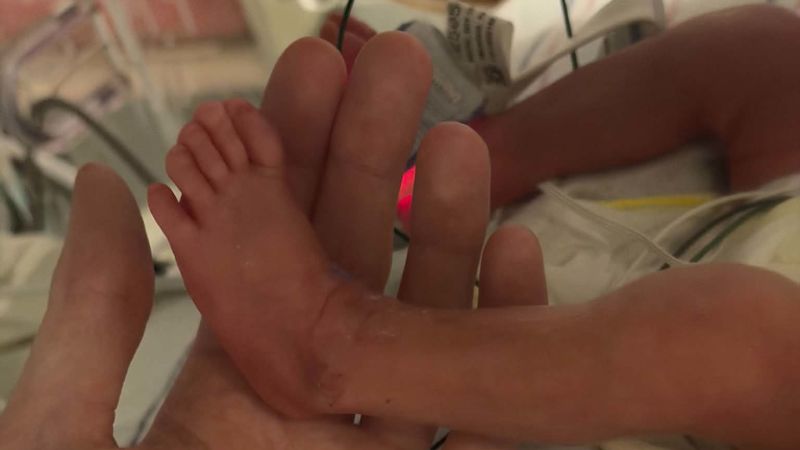
Brittany Nicole Sponenberg’s son has been in a neonatal intensive care unit in Danville, Pennsylvania, for almost two months while his underdeveloped lungs and gut grew strong enough to handle regular breathing and feeding.
Last week, Sponenberg said, she sat silent on the phone with a doctor while he explained that her tiny baby had been exposed to measles while in the NICU. The area where her son is hospitalized is the epicenter of an expanding outbreak of measles, the world’s most contagious infection.
As the infection tears through unvaccinated families, it’s showing up in places where people who can’t be protected for various reasons – either because they’re too young or old, or because their immune systems don’t respond well to vaccines – have to live, work or go to school. That’s forcing people into difficult circumstances to protect themselves or their loved ones.
Sponenberg and her baby were exposed to measles at Geisinger Medical Center by an adult who visited the unit between Friday, August 14 and Monday, August 17. According to information provided by the doctor treating her son, the person developed a fever and a rash on August 17 and tested positive for measles the next day.
Sponenberg said she wasn’t told until three days later, after her son had already been transferred to a different hospital closer to their home.
“And he told me all of that, and I’m like, are you kidding me right now?” Sponenberg said.
Geisinger Medical Center is in Lancaster County, which is home to large Amish and Mennonite communities. Although Amish and Mennonite people don’t universally reject vaccines, they tend to have lower vaccination rates than the general population.
Of the nearly 400 measles cases confirmed by the Pennsylvania Department of Health this year, about half have been in Lancaster County. On Tuesday, the state reported that two people with measles in Lancaster County had died, the first measles-related deaths there in 35 years.
Kimberly Reichenbach, 50, of Leola had to retire from her career as a corrections officer after health problems including severe asthma made her physically demanding job too difficult.
For the past few years, she’s made a little money driving Amish customers on their regular errands. Many Amish people shun certain kinds of modern technology, and Reichenbach says many now use ride services to get around.
But Reichenbach said she quit driving altogether last week after she and her longtime partner, who has type 1 diabetes, separately drove clients who were sick or who had been exposed to measles.
At the end of one trip, one woman said she was grateful to be able to pick up groceries because her whole family had measles and she wanted to restock her pantry before she too became too sick to get out of bed.
Reichenbach, who has lived in the area for the past 30 years, said her Amish neighbors tend to brush off their own health concerns and have told her they don’t like to take medicine to ease their symptoms.
“It’s a tough place to be immune-compromised,” said Reichenbach, who has a teen daughter. “If I get sick, who’s going to take care my family?”
Last week, another client she drives to and from her job at a bakery got into the car coughing and sneezing.
Her client said that it was just a cold and that was getting better, but Reichenbach said her explanation didn’t ring true.
“I even came home that day and said to my boyfriend, ‘I’m really concerned about this because I know that, especially in Lancaster, it’s starting to get bad,’” she added. “I canceled everybody.”
Watching and waiting
Geisinger isn’t the only hospital where young patients have unwittingly been exposed. Penn State’s Golisano Children’s Hospital warned families that someone had tested positive after being in the main lobby for two and a half hours on August 17. UPMC Children’s Hospital Emergency Department was also the site of recent exposures, according to the Allegheny County Health Department.
On Tuesday, Dr. Jeffrey Martin, who practices at Lancaster General Health, urged people seeking medical care to “please call ahead” before they go to a hospital, clinic or urgent care if they think they might have measles.
“Calling ahead allows healthcare workers and teams to prepare and arrange for safe evaluation, minimizing exposure to others and protecting vulnerable patients who may be in waiting areas,” Martin said. “This simple step can significantly reduce the risk of spread.”
The Geisinger doctor who spoke to Sponenberg last week characterized her son’s risk of getting measles as low, she said, but explained that the baby would need to get an additional medicine, given through an injection in the top of each thigh, for protection. He would also be transferred to an isolation room in the hospital with special air circulation to keep any germs from escaping should he fall ill. He won’t completely be clear of the risk for 28 days, Sponenberg said.
“It really extremely upset me, because he was already having things to overcome. He had to get stabbed in the leg with something he shouldn’t had to get stabbed in the leg with yet. He shouldn’t have needed that medication yet, being that young,” Sponenberg told CNN.
“He’s already had to overcome so many battles already. This was not a battle I wanted to add to us having to overcome.”

Sponenberg said she’d spoken with other parents who were also furious.
“Some babies can’t handle the loud noise from the pressure-controlled room in isolation, so they are having a rough time, especially the really, really little ones,” she said.
Premature infants are among the most defenseless patients in a hospital, said Dr. Buddy Creech, a pediatric infectious disease specialist at Vanderbilt University in Nashville.
“Premature infants are vulnerable to infections for multiple reasons,” he said. They’re born before antibodies – protective proteins that recognize incoming germs – can be transferred from mother to baby during the later stages of pregnancy.
“They are often supported with medical devices and for very early infants. Their skin does not yet serve as an effective barrier to protection,” Creech said.
Children under the age of 5 who get measles are more likely to develop serious complications, including pneumonia and brain swelling, compared with older kids.
In response to the incident, Geisinger changed its screening protocols. Going forward, the hospital said in a statement, only parents or legal guardians will only be allowed in the NICU, or its nearby children’s hospital, and only as long as they don’t have signs or symptoms of measles. They will be encouraged to wear a surgical mask before entering the unit.
“These screenings are in place to best protect our patients, visitors and staff as measles cases are rising in the area,” Geisinger said in a statement to CNN.
Sponenberg said she doesn’t understand why the hospital doesn’t require visitors to show vaccination records before they can come in.
Pediatric infectious disease experts said hospitals almost never restrict a parent’s access to their child’s bedside. If a parent has an illness so contagious that the hospital can’t adequately protect other patients from it, such as tuberculosis, the parent and child would probably be put in an isolation room with special airflow to contain germs. The room would have its own bathroom, and meals would be delivered to prevent the person from walking around the hospital.
“Our teams established entrance screenings to best protect our patients, visitors and staff as measles cases are rising in the area. However, the screening process relies on accurate and complete information being shared at the time of entry,” Dr. Michael Fitzpatrick, Geisinger’s Central Region chief medical officer, said in a statement on the hospital’s website.
“We understand how important it is for parents and immediate family members to be present with loved ones in the NICU, and we did not make this change in visitation policy lightly. We carefully considered the impact on families before determining that these temporary restrictions were necessary to protect our most vulnerable patients.”
Measles was declared eliminated in the US in 2000, and until recently, most of the country had maintained vaccination levels high enough to to prevent ongoing transmission. But in many areas, that safety net has worn thin as shifting states laws grant more personal belief exemptions that allow unvaccinated children to attend school.
At the same time, government officials have cast doubt on the safety of vaccines, further discouraging vaccination. Earlier this month, President Trump signed an executive order directing the US Department of Health and Human Services to find a way to split up the measles, mumps and rubella (MMR) vaccine into three separate shots.
“I think you’re going to see a very big difference in the rates of autism,” Trump said when he signed the order, although dozens of studies have investigated a link between vaccines and autism and failed to find any connection.
Utilization of vaccine exemptions is more common than it’s ever been. Recently published data by the US Centers for Disease Control and Prevention shows that 4.2% of kindergartners had an exemption for at least one required vaccine during the 2025-26 school year.
Exemptions increased in all but nine states, and nearly half of states report exemptions exceeding 5%, according to the CDC.
Last year, about 88% of kindergartners and 83% of seventh-graders started school fully vaccinated against measles in Lancaster County, far lower than the 95% threshold that creates community protection or herd immunity. When 95% of people are immunized, the infection doesn’t spread easily from person to person.
But those are averages spread across the entire county. While some public schools report that nearly all students have been vaccinated against measles, mumps and rubella, some Mennonite and Christian schools in Lancaster County report vaccination rates below 50%.
Reichenbach said it’s been alarming to her to see how casually her neighbors treat measles.
She was supposed to go visit her young niece and nephew this week, but her doctor advised against it.
The doctor told her that because she and her boyfriend are immunized, they will probably be fine after their exposures, but “they’re babies. They’re toddlers. I wasn’t going to risk it.”
CNN’s Deidre McPhillips contributed to this report.
