
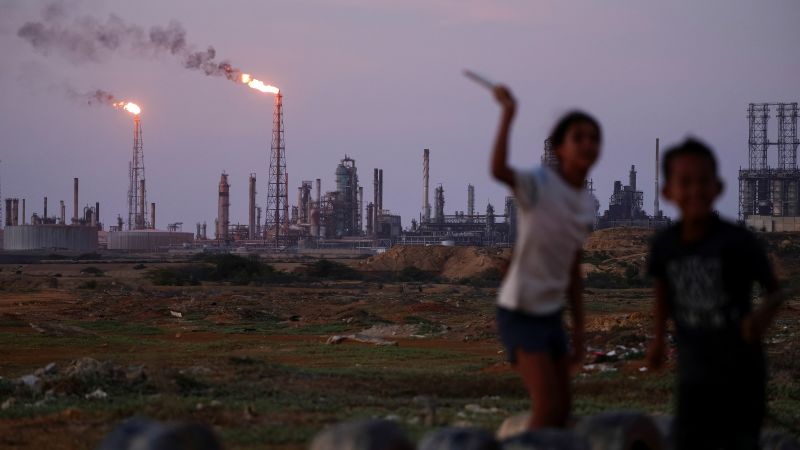
America needs Venezuelan oil — probably more than at any point since the oil crisis of the 1970s.
But President Donald Trump has struggled to convince American oil companies to make significant investments in Venezuela’s oil operations after the United States captured Nicolás Maduro in January and arrested him on conspiracy charges. Publicly bullying oil executives failed. So too did several deals with Maduro’s replacement, Delcy Rodríguez, to reform the country’s oil industry that she had once led.
Removing Venezuela’s leader in a complex military operation turned out to be the easy part.
But Friday’s stunning announcement — that the United States entered a deal to take majority ownership in a joint oil venture with a Venezuelan energy company — could be a game-changer. In the long run, it could serve as a win for both the US oil industry and the Venezuelan economy.
It may finally offer skeptical US companies the assurance they’ve been looking for to invest safely in Venezuela.
Venezuela is crucial to America’s energy security.
The United States has more than quadrupled its crude imports from Venezuela this year, reaching the highest amount of oil from the country (roughly 600,000 barrels per day) since the first Trump administration imposed sanctions in 2019. Venezuela is now the No. 2 source of imported oil to the US, behind only Canada, according to the Energy Information Administration.
The deal Trump announced Friday could significantly reinforce that relationship: The United States will take a 55% stake in a new joint venture with a private Venezuelan operator, according to a White House official. The 100-year oil field lease will create the world’s second-largest oil company, measured by total reserves, behind Saudi Aramco.
Venezuela has 303 billion barrels of proven oil reserves, and the newly formed company will control 65 billion of those barrels. That would more than double the 46 billion barrels in oil reserves that the United States already controls, according to the EIA.
Although the United States is a net exporter of oil and fuel — and the world’s largest crude producer — it still imports significant amounts of oil. That’s because US oil is the light, sweet variety, good for making gasoline but not the heavier fuels. Venezuelan oil, by contrast, is heavy, sour sludge, which can more easily be distilled into asphalt, industrial oils, diesel and jet fuel.
Many US refineries are tailor-made for Venezuelan oil. They were mostly built in the 1970s, when Venezuela was one of America’s chief sources of crude. So an increase in Venezuelan oil imports would make America’s refineries more efficient.
That’s particularly important after the Iran war disrupted about a fifth of the world’s oil supply. The United States has become a supplier of last resort for many countries, particularly those that were unable to reliably get jet fuel or diesel from the Middle East.
It could also help play an important role in restoring America’s Strategic Petroleum Reserve, which the Trump administration has been draining to counteract the lack of oil exports from the Persian Gulf. The SPR is at its lowest level since 1982, when the Reagan administration was filling it. That would put the US in a precarious position if it needed to respond to another energy crisis.

Venezuela has made good progress ramping up its oil production since the US government captured Maduro. The country is producing about 1.2 million barrels per day, roughly 150,000 barrels per day more than at the start of the year, according to Luisa Palacios, the former Citgo chair and current managing director of Columbia University’s Center on Global Energy Policy.
Still, that’s significantly less than the 3.5 million barrels per day that the country produced before the socialist takeover in the late 1990s. The Hugo Chavez and Maduro regimes allowed the country’s oil infrastructure to deteriorate beyond repair.
To restore Venezuela’s oil operation to its former output, billions of dollars of foreign investment over at least a decade will be necessary, Palacios said.
Other than Chevron, the only US oil major that has maintained a constant presence in Venezuela throughout the past several decades, no American energy companies have been willing to dedicate resources there. The government remains corrupt, evidenced by its miserable response to the recent devastating earthquake that killed thousands. Crime remains rampant, and the country’s political stability remains tenuous.
But the United States’ unusual direct ownership of a private, foreign oil field could signal to America’s oil majors that it’s safe to invest in Venezuela again.
“This could be a good thing as the major oil companies are presumably now dealing with a US legal framework which could accelerate investments,” said Andy Lipow, president of Lipow Oil Associates.
Chevron may be in the driver’s seat to take advantage of the government’s involvement in Venezuela. But Chevron’s investments alone — if it ramps up spending in the country — will be insufficient to get Venezuela back up to its production peak, noted Rob Thummel, senior portfolio manager at Tortoise Capital. And other companies already have significant investments in other parts of the world.
“An investment in Venezuela will have to compete for capital with other projects that are on the docket for the oil majors,” he said. “It will likely be years rather than months before additional oil is produced in Venezuela.”
Venezuela could certainly use the economic boost. The deadly earthquake and decades of government mismanagement have left the country in ruin.
A 45% interest in the deal won’t solve those problems, but it could be a selling point to a skeptical Venezuelan public.
Venezuela’s new government opened its oil industry to private-sector participation. But without sufficient protections for investors, few have been willing to take the risk.
The tragic earthquake added to the country’s political and business instability. Even though Venezuela’s energy infrastructure emerged mostly unscathed — only the country’s smallest refinery suffered some damage — Venezuela’s lackluster response exposed deep fractures in the country’s government and inspired little confidence for any hope for political stability, noted Palacios in a Columbia University podcast earlier this month.
Nevertheless, Venezuela needs a thriving oil industry to solve the humanitarian crisis, she said. It needs the revenue to rebuild itself.
