
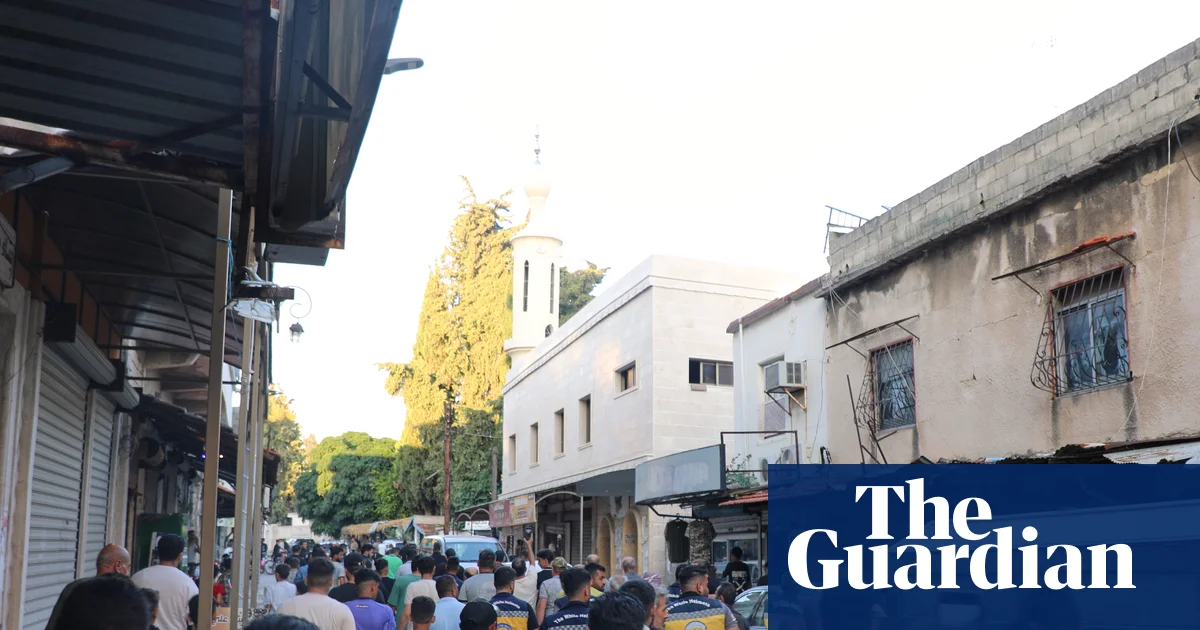
Syrians have protested over the death of a man who was arrested and allegedly beaten by security forces, sparking widespread anger at a practice thought to have ended with the fall of Bashar al-Assad.
A crowd gathered in the city of Aleppo, demanding accountability for the security forces who are alleged to have carried out the torture, with participants holding signs and slogans such as: “Do not repeat the same oppression that we revolted against.” Protests were also planned to take place in front of Syria’s parliament in Damascus on Tuesday, as well.
Mohammad Ghamira, a 29-year-old father of two and former volunteer in the White Helmets, had visited a police station in the coastal province of Latakia last week after an accusation of theft.
Ghamira emerged from the station in a critical condition, and died in hospital on Sunday from “complications from cerebral and gastrointestinal haemorrhaging” that “resulted from a beating he sustained after being detained”, said Raed al-Saleh, the former head of the White Helmets and current Syrian minister of emergency and disaster management.
A picture of Ghamira pre-detention, smiling and healthy, next to another picture of him unconscious in a hospital bed with bruises on his body, went viral, sparking outrage in Syria.
Ghamira’s parents told the police station chief prior to their son’s detention that he had haemophilia, a disease which makes it hard to stop bleeding once started, and asked them not to beat him. Even with the warning, Ghamira was beaten while in custody, Issam Ghamira, the man’s uncle, told Syrian state media.
The Syrian interior ministry promised accountability for Ghamira, forming a committee to investigate his death and detaining seven members of the interior ministry for questioning. The interior minister, Anas Khattab, vowed a “fair punishment” after the conclusion of the investigation.
“I confirm that any violation or abuse by the elements of the ministry of interior will be dealt with firmly within the laws and procedures followed and any violator will receive his fair punishment,” Khattab said in a post on X.
The interior minister spokesperson Nour al-Din al-Baba acknowledged issues in the ministry, but promised that justice would be served. Al-Baba said that the investigative committee met with family members on Tuesday and informed them of the progress of the investigation.
Despite the promises of accountability, Syrians were incensed by the allegations of torture, enraged that the practice continued even after the 14-year revolution aimed at stopping such brutality. Al-Assad’s regime used mass detention and torture on a systematic scale to control its population, accelerating its brutality when protests broke out against the government in 2011.
The current government, made up mostly of former members of the Islamist rebel group Hay’at Tahrir al-Sham (HTS), overthrew al-Assad in a lightning offensive in December 2024. It promised an end to the atrocities committed under the police state that al-Assad oversaw, dismantling the dense network of security agencies that oversaw the country.
However, rights groups have alleged that torture continues to be used in Syrian detention centres, and that the policy of abuse is being rebuilt.
Syrians for Truth and Justice documented 14 cases of individuals being tortured or dying in custody from June 2025 to June 2026, and said that “the change in political authority has not yet been accompanied by the effective dismantling of the structures and practices that enable torture”.
STJ collected testimonies that showed severe beatings, electric shocks, humiliation, threats, deprivation of basic necessities by Syrian security forces across different agencies, often seemingly motivated by sectarian discrimination.
The rights group pointed to a lack of oversight and accountability for militias and members of the security forces as an explanation for the persistence of torture in Syria, rather than a centralised policy of torture originating from security agencies themselves. It contrasted this with al-Assad’s regime, where torture was not due to gaps in law, but state policy itself.
The report echoed the findings of the UN independent commission of inquiry in March, which documented torture and abuse in 30 official and makeshift detention facilities across Syria in 2025.
Civil society groups called for protests and demanded accountability, pointing to the sacrifices of those who died under torture fighting for freedom in Syria.
“So many sacrificed dearly for freedom and dignity, to close the dark chapter of their country’s history and to end these practices forever,” said Diab Serieh of the Association of Detainees and the Missing in Sednaya Prison. “Justice for [Ghamira], and for all those forcibly disappeared and under torture in detention, remains an unwavering demand that we will never abandon.”
