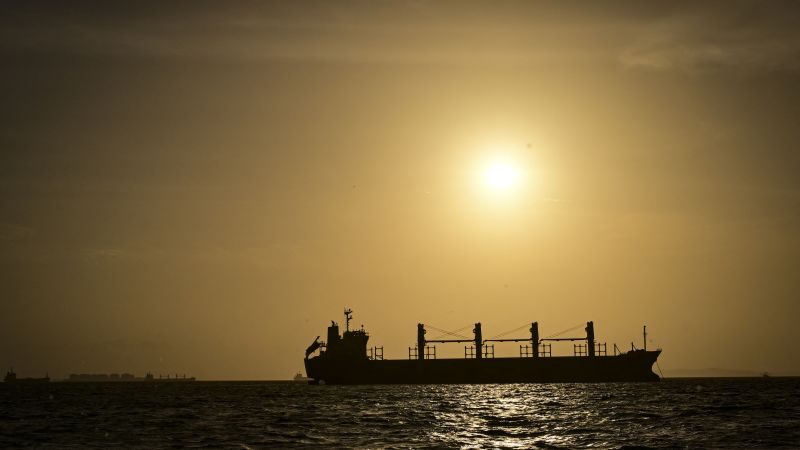
In early August, dozens of vessels were waiting for their turn in the Panama Canal. Some had been stuck for more than a week. One chemical tanker has been there over a month. Then on August 10, a large container ship paid a staggering $4 million to fast-track its trip — leaving others, either unwilling or unable to shell out that kind of sum, in maritime limbo.
Logistics company Flexport, which had 30 containers aboard that lucky ship, said the backlog at the Panama Canal’s Pacific end is the worst since May, when wait times increased because of conflict over the Strait of Hormuz.
But now this commercial stress is being amplified by an unusually strong climate event: El Niño. Consumers are expected to take the hit.
“The ripple effects are significant through supply chains and all the way to consumer prices at stores,” said Benjamin Gedan, senior fellow and director of the Latin American program at the nonpartisan think tank Stimson Center.
🌧️ Get your local forecast with the CNN Weather app
Global weather patterns are shifting as this El Niño — predicted to be a record-breaking one — makes the dry season in some places wetter, and wet season drier. One of those locations is the Panama Canal, a critical chokepoint that moves about 5% of the world’s shipping. The narrow, 50-mile artificial waterway cuts through the Central American country, connecting the Atlantic and Pacific oceans and saving time and fuel along the shorter transit route.
The United States is the canal’s biggest user — about 70% of all the goods moving through it are coming to or going from the US.
The Panama Canal moves ships across the isthmus through a system of locks — water-filled chambers that can raise or lower a vessel like a flight of stairs. The locks are fed by freshwater from Lake Gatun, but during the extreme droughts Panama saw during El Niños in 2023 and 2024, the lake’s levels dropped to historic lows, reducing the number of ships that could pass through the canal from 36 per day to 24.
Panama’s wet season began in May and will run until December. In June, the US National Oceanic and Atmospheric Administration declared the official start of a new El Niño, which is expected to be historically strong and peak somewhere between October and December. For Panama, the result is a wet season that’s already been drier than usual and is likely to get worse.

Panama City has seen 75% of its average rainfall since May 1. Other places are even drier. The western city of David has seen just 60% of its average rainfall over the past 90 days. The cumulative rainfall across the canal watershed since May has been 34% below the historical average, the Panama Canal Authority said on Thursday. The canal is already being forced to adapt its operations to these decreased water levels.
One way is by adjusting the draft for vessels going through the locks. The draft is the vertical distance from the surface of the water to the lowest point of a ship’s hull. It indicates how deep the boat sits in the water, and the Panama Canal Authority announced a 48-foot draft limit — down from the usual 50 feet — that goes into effect in September. A further downward revision is expected soon after. A lower draft means ships must reduce the weight of their cargo. Less cargo capacity per ship means higher prices for consumers.
Some shipping companies are already feeling the trickle-down effects. Mediterranean Shipping Company (MSC) announced on August 12 that draft restrictions reducing vessel capacity have led it to increase its Panama Canal surcharge. This fee for container ships offsets the costs associated with transiting the waterway. MSC’s increase goes into effect September 12 “until further notice” and will apply to shipments from Southeast Asia, China, Korea and Japan bound for the US’s East Coast and Gulf Coast, the shipping company said.
Authorities have also begun to reduce the daily number of ships that can transit the canal. Beginning September 4, 34 ships will be allowed through per day, falling to 32 ships by September 15.
The reduction will likely worsen existing delays and exacerbate transit fees, experts say. While the reductions aren’t as disruptive as those in previous El Nino years, “the potential is still there to get worse,” Henry Ziemer, Americas Program fellow at the Center for Strategic and International Studies (CSIS), said.
⛅ Get CNN Weather in your inbox
- The forecast is just the beginning. We’ll send you expert coverage and the stories behind the weather — so you always know more than just the number. Sign up for the newsletter
It’s not just draft limits and reduced capacity driving up shipping costs — it’s also the canal’s auction slots, which have become increasingly expensive.
The Panama Canal operates on a reservation system. Ships book slots to transit, similar to how passengers book seats on airplanes in advance. For ships that did not book a slot in advance, the Canal Authority typically offers three-to-five daily slots for auction.
Increased demand for canal transits amid tensions around the Strait of Hormuz has already taken the average auction prices from about $100,000 to about $380,000 — with one auction slot even going for $4 million, Panama Canal Deputy Administrator Ilya Espino de Marotta said in May.
Experts agree that these increased prices would ultimately fall on the consumer, as they did during supply chain disruptions from previous El Niños.
While some ships may wait to transit to avoid the higher fees, those carrying more time-sensitive cargo are likely to take the plunge and pay the steep transit prices, driving up the price of those goods. For example, active pharmaceutical ingredients used to make medicines like Tylenol and some prescription drugs come, in large part, from China and are believed to transit through the Panama Canal to the US East Coast, said Prashant Yadav, a senior fellow at the Council on Foreign Relations who tracks healthcare supply chains.

Shipping companies carrying merchandise from online retailers and e-commerce platforms that may penalize later deliveries or vessels carrying season-dependent fashion merchandise might also take on higher transit costs to get their shipments delivered on time.
The cost increase won’t just affect goods that go through the canal. There’s a ripple effect on ground transport, too.
If there are significant holdups at the canal, vessels will bring their cargo to a US West Coast port and truck it across the country, Yadav said. That, in turn, makes less ground transport available, increasing the cost of shipping overland and raising the price on a wide range of goods that never even transited the canal.
Armenak Shahbazian, president and co-founder of logistics company Polo 4PL says his team is already feeling the effects of El Niño on the canal, with increased demand on land transport, rerouting and higher prices, which are passed down to their customers. His team has seen many cancellations by importers who were shipping to the US East Coast or Texas via the canal, and who are now considering rerouting to Californian ports in Los Angeles and Long Beach. Worried the drought will affect their shipments, they aren’t necessarily looking at the cheapest option anymore, but at the one that will get their products where they need to go in time, he said.

“We’re having issues here with a lot of domestic shipments where railway is overpacked,” he said, adding that trucking capacity at his company is also tight.
“So on top of this with El Niño happening, there’s some bottlenecks in the supply chain that we’re monitoring right now and we’re trying our best to see how we can predict things,” he said.
Oil prices are already ticking up as Iran maintains a hardline stance over its control of the Strait of Hormuz.
Most energy imports to the US don’t involve the Panama Canal, but it’s a different story for US energy exports. US petroleum products heading to Asia could face trouble, which could become problematic for Asian countries attempting to replace their missing Middle Eastern oil with American crude. Those countries could see surging energy prices on both fronts.
“(It’s) another serious headache in global supply chains at a time when economies are already trying to adapt to increased cost related to the Strait of Hormuz crisis,” Gedan from the Stimson Center said. “Not only does the cost of shipping filter down to consumer prices, but if it’s making energy less accessible, that makes everything more expensive.”
The US has been comparatively insulated from chokepoints like the Strait of Hormuz, Ziemer from CSIS said. Not a lot of US exports or imports pass through Hormuz — whereas about 40% of all US-bound container traffic transits the Panama Canal.
In recent months, the canal has become increasingly crucial for the US.
On August 10, President Donald Trump extended a waiver for 90 days, allowing foreign ships to transport commodities like energy products between US ports, to help counter rising gas prices caused by the Iran war. A tracker set up by the Cato Institute shows at least 49 of the 215 voyages by foreign-flagged vessels under the waiver have used the Panama Canal to make the journey, as of August 11.
If Panama Canal transits fall to the levels they did during the droughts in 2023 and 2024, a much higher economic disruption could be on the horizon, for the US in particular, Ziemer said, noting though that the disruption might be less of a pricing issue for energy and more for consumer goods like cell phones, computers and produce.

As the impending effects of El Niño loom large over Panama, the Canal Authority is working to make operations more sustainable amid climate challenges, especially since the canal’s freshwater source also serves 2 million people in nearby communities — nearly half Panama’s population.
The Rio Indio reservoir project is a plan to create a new lake to feed the canal, increase water storage capacity, mitigate lower water levels and serve as a safety measure against future droughts. But it is still in very early stages and has not yet begun construction.

The Panama Canal Authority is also pursuing the construction of a liquefied petroleum gas (LPG) pipeline to transport fuel, reducing the need for large LPG-carrying vessels transiting the waterway.
But while consumers brace for the full force of El Niño, increased demand might be just what the canal, itself, needs.
High traffic brings in money for the canal and Panama, Gedan said. “Which is nice and maybe gives it a bit of a financial buffer before this really tough time that it’s expecting in the next few months.”
