
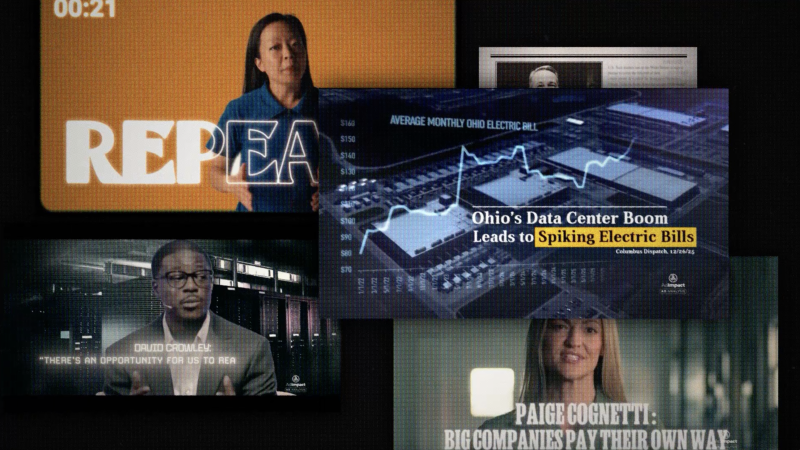
Across the country and the political spectrum, candidates are embracing a growing backlash to artificial intelligence and the infrastructure required to power it – a resistance shaking up races from the local level to the highest national offices, a CNN analysis of campaign ads found.
More than $31 million has been spent on political ads mentioning data centers so far this year, spiking last month, when more than 8% of all campaign spending on broadcast TV went to data center or AI-related spots, according to tracking from the firm AdImpact. That’s up significantly from less than 1% of ads last year.
Those ads, which came from candidates and groups of both political parties, were united in their overwhelming criticism of data centers – more than 99% of the spending this year went to spots against AI infrastructure projects.
In Michigan, a congressional hopeful filmed an ad from a farm field he said was at risk of being replaced by “a massive data center that’ll jack up our energy bills and ruin our home values.”
In suburban Missouri, both leading GOP candidates for a county executive seat spent their entire TV ad budgets vowing to stop data centers and accusing each other of being beholden to developers.
And two different candidates in Wisconsin and California who happen to share a first name have both recently been mocked as “Data Center David” by their opponents.
“Data centers have picked up a unique bipartisan opposition in large part because they are so local as an issue,” said Daniel King, a research fellow at the Foundation for American Innovation. “Regardless of where party lines fall at the national level or on larger issues, both sides have been able to really pick up the spike.”
Facing that onslaught of negative political advertising, interest groups related to the AI industry have scrambled to pour millions into key races, federal election records show.
Yet those industry ads rarely discuss the AI industry or infrastructure. One major super PAC funded in part by an OpenAI executive bought millions in ads this year without mentioning AI or data centers in any of its broadcast spots, CNN’s review found.
In the lead-up to a bruising midterm battle for control of Congress, the data on ad spending points to a frantic rush by both parties to position themselves correctly on a critical jump-ball debate. Even major lawmakers who aren’t facing challenges are tacking toward more restrictive rules on data centers or even moratoriums on their construction.
“It isn’t intrinsically a right or left issue,” said Clifford Young, the chair of research firm Ipsos Public Affairs. “It’s a boogeyman for everyone. It plays into this underlying belief that the system is broken.”

Campaign ads from Texas and Michigan take aim at data centers

As demand for the computer processing that powers artificial intelligence has skyrocketed, big tech companies are scrambling to spend hundreds of billions of dollars on new infrastructure – including on more than 2,000 data centers in planning stages, according to the tracking firm Cleanview.
Until recently, that construction boom was a political non-issue. In 2024, there wasn’t a single election ad on broadcast TV that mentioned data centers, according to AdImpact’s database, and in most of 2025, only a handful discussed them, largely in down-ballot state races.

But over the last year, there’s been a tectonic shift in public sentiment, driven by skepticism about the industry and concerns over property rights, environmental impacts and especially spiking utility bills.
The data centers that run AI use powerful computing chips that are more energy-intensive than previous generations, which could lead to a 6% rise in electricity bills nationally over the next year, a Goldman Sachs analysis projected, with the biggest jumps for those living near data centers.
A Fox News poll in July found 70% of voters oppose building data centers in their area to support AI. In a Reuters/Ipsos poll from June, 59% of adults said they’d oppose a data center being built within 10 miles of their home. And a Pew Research survey released this month found “52% of Americans say they are more concerned than excited about the increased use of AI in daily life – up from 37% in 2021,” with a large majority expecting AI to decrease the number of jobs.
Politicians from both parties have taken note of that shift – and the issue has now moved to center stage in some of the most impactful races in this year’s midterms.
The front line might be a key race for US Senate in Ohio between Democrat Sherrod Brown and GOP Sen. Jon Husted.
In his previous role as lieutenant governor, Husted recruited the tech industry to Ohio – pre-AI boom, when the issue was relatively uncontroversial. In 2019, he hailed a new $600 million Google data center as “great news for our state.” Ohio is now home to more than 200 data centers, according to the Data Center Map tracking project, ranking sixth nationally.
That’s fueling Brown’s attacks, as outlined in a recent National Republican Senatorial Committee strategy memo obtained by CNN, which notes that “the new ingredient (and the new problem) is data centers.”
“Brown is using it because it works,” the memo notes. “More than any other thing in this race, data centers are the anchor hanging around Husted’s neck.”
Since July, Brown’s campaign has put more than $3.5 million behind three separate TV spots hammering Husted on data centers, per AdImpact, running thousands of times. In the ads, Brown blames Husted as a “a chief reason Ohio has so many data centers,” and pledges to “require the data centers pay the full cost of their electricity, not you.”
“He’s been called the face of data centers in Ohio,” says one ad from Brown targeting Husted.


Husted has tried to recalibrate. Last month, he introduced the “Ratepayer Protection Act,” legislation aimed at limiting data centers’ impact on residential electric bills. In a statement, a campaign spokesperson said that Husted believes “data centers are, and should remain, a local decision,” and accused Brown of flip-flopping on the issue.
In the state’s competitive race for governor, Republican Vivek Ramaswamy and Democrat Amy Acton have also strained to outdo each other with multi-point plans imposing strict regulations on tech companies and protections for residents.
In Wisconsin, with its own hotly contested gubernatorial race, data centers have also become a defining issue. Though it has far fewer data centers than Ohio, Wisconsin hosts several massive developments, including a 315-acre Microsoft campus in Mount Pleasant touted as “the world’s most powerful AI datacenter,” and plans for a sprawling 672-acre facility in Port Washington, backed by Oracle and OpenAI.
In a close Democratic primary, state Rep. Francesca Hong emphatically backed a data center moratorium, contrasting her stance with Milwaukee County Executive David Crowley’s more measured regulation pitch. “Unlike the other candidates, I’m not bought by corporations, so I’ll actually stop AI data centers,” Hong said in one of her ads.


After Crowley prevailed, his Republican opponent, Rep. Tom Tiffany, picked up where Hong – a democratic socialist – left off. He’s hammered Crowley over data centers with a campaign ad nicknaming him “Data Center David Crowley,” featuring a clip of him touting Wisconsin’s potential to be “an AI and a data hub … for the entire globe.” Tiffany’s ad touts his support for eliminating state tax incentives for the industry.
Crowley has hit back by vowing to “hold data centers accountable and make them pay,” and criticizing Tiffany’s support for legislation that could have preempted states’ ability to regulate AI (language which was dropped from the final bill).
In a statement, Crowley said that “when I’m governor, I am going to aggressively protect Wisconsin citizens from the abuses of these big tech billionaires and their unregulated data centers.”
Wisconsin governor candidates air dueling ads on data centers

Data center resistance has powered other grassroots candidates nationally. Will Lawrence, a climate activist who unexpectedly won the Democratic nomination in Michigan’s toss-up 7th District, ran TV ads pledging to “stop AI data centers,” and credited that focus for his success.
Abdul El-Sayed won Michigan’s Democratic Senate primary the same night as Lawrence, campaigning on extensive new standards for data centers. And earlier this month, El-Sayed’s GOP opponent, former Rep. Mike Rogers, said he now supports a one-year moratorium on building new data centers.
These advertising battles are also playing out on the most local levels, the AdImpact data shows.
In the GOP primary for county executive of St. Charles County, Missouri, earlier this year, 99% of campaign spending on broadcast TV mentioned data centers, with both leading candidates accusing their rival of supporting data center proposals. The county last month passed a six-month moratorium on large-scale data centers and one of its largest cities recently banned new developments.
“No one wants to live next to a giant behemoth,” said Kara Elms, a local resident who was among those protesting the data centers. “Both Democrats and Republicans can jump on that issue.”
AI companies and industry allies are also lining up to shift the political momentum before the midterms.
Tech giants like Meta, Google and Anthropic, a prominent venture capital firm, and top AI executives have donated more than $190 million to super PACs and nonprofits that have spent over $60 million on independent expenditures in the midterm elections so far.
Super PAC Leading The Future has taken in $50 million from the Silicon Valley venture capital firm Andreessen Horowitz, plus another $25 million from OpenAI president Greg Brockman and his wife, Anna. Through June, it’s reported spending nearly $45 million, often directed at candidates taking a hard line on AI and data center regulation, according to Federal Election Commission records.
In the crowded Democratic primary for New York’s 12th congressional district, the group and its proxies spent millions against state Assemblyman Alex Bores, who led a novel effort to regulate the industry in the state legislature. He lost the nomination to Assemblyman Micah Lasher.
Notably, Leading the Future’s ads have avoided AI or data centers. While two of its proxy groups, American Mission and Think Big, have spent a combined $8 million on broadcast TV ads in races around the country so far this year, none have mentioned AI or data centers, AdImpact’s tracking shows. Instead, they’ve touted candidates as a “proven fighter” or highlighted endorsements from President Donald Trump.
Similarly, California Leads, a group funded by Meta and Google, has spent more than $1.5 million on broadcast ads supporting moderate candidates in state legislative elections, but avoided mentioning tech, AI or data centers.
One industry heavyweight has taken a different approach. Public First Action, a nonprofit advocacy group backed by $40 million from Anthropic, says it supports robust AI regulations aimed at safety and responsible development, and has spent more than $10 million along with affiliated super PACs on ads this cycle.

It has boosted lawmakers like Bores, and addressed AI policy head-on, such as one ad for Texas GOP Rep. Nathaniel Moran highlighting his bill to increase AI regulations. “No technology should be more powerful than the people it serves,” a voiceover declared.
Several other tech giants have been airing more general ads to encourage support for their data center projects outside of the fever pitch of election contests.
In 2025, Meta spent more than $6 million on broadcast ads promoting jobs created by its data centers in Iowa and New Mexico. More recently, Oracle aired similar ads, featuring young women in coffeeshops talking directly into the camera about new jobs and investments that come with the company’s new projects.
“It’s a data center, done right,” a spokeswoman declared in several of the ads.

Meta and Oracle push positive message about data center projects

Politicians already in office are urgently moving to avoid blame from voters alarmed by AI. Several prominent governors eyeing upcoming reelection have embraced calls for data center pauses and moratoriums – creating strange political bedfellows.
Both the Republican governor of Texas, Greg Abbott, and the Democratic governor of New York, Kathy Hochul, have backed versions of a data center pause – particularly consequential in their large states with major economies.
Hochul signed a one-year moratorium on new large-scale data centers in July, the first of its kind in the nation, explaining at an event that the move would “give us some breathing room” amid perhaps “the most significant economic upheaval in history.”
Abbott, like Husted, was once a key industry ally – helping grow Texas into a national leader with 537 data centers, second only to Virginia, during his three terms as governor. Now, he favors pausing construction on new data centers pending an audit of their electricity and water usage. “Simply put, Texans must come first,” he said.

His pivot illustrates the changing incentives, even for traditionally business-friendly Republicans.
Potential presidential hopefuls like Democratic Pennsylvania Gov. Josh Shapiro are also shifting. In 2025, he welcomed a $20 billion investment from Amazon, remarking that his state was “all in on AI.” Now, this month, he announced an executive order restricting the development of data centers, eliminating fast-track approvals and expanding the review process – though he stopped short of an outright ban. Shapiro accused data center builders of “scaring our communities, being aggressive with township officials,” and “bullying our neighbors.”
Cementing his pivot, he launched an attack ad this month against GOP opponent Stacy Garrity, replaying clips of her saying that “we could be the leader in AI.”
Geopolitics is also driving the conversation. Defense hawks and other security-minded lawmakers focused on competition with China argue that limiting data center development could harm American progress and forfeit leadership in the critical sector. On the campaign trail in Michigan this month, Republican House Speaker Mike Johnson said that “a broad moratorium against data centers is kind of a dangerous prospect right now.”
And Trump, despite his penchant for populism, has taken a position as a data center advocate and AI accelerationist. “Many of them are designed in a very beautiful way,” the president commented earlier this month. “It’s really very positive.”
But with characteristic bluntness, he also noted, “I would say that maybe it could use a little public relations help.”
