
The Justice Department is investigating whether Nvidia tried to skirt antitrust scrutiny of a deal it struck with the artificial intelligence chipmaker Groq last year, according to two people with knowledge of the inquiry.
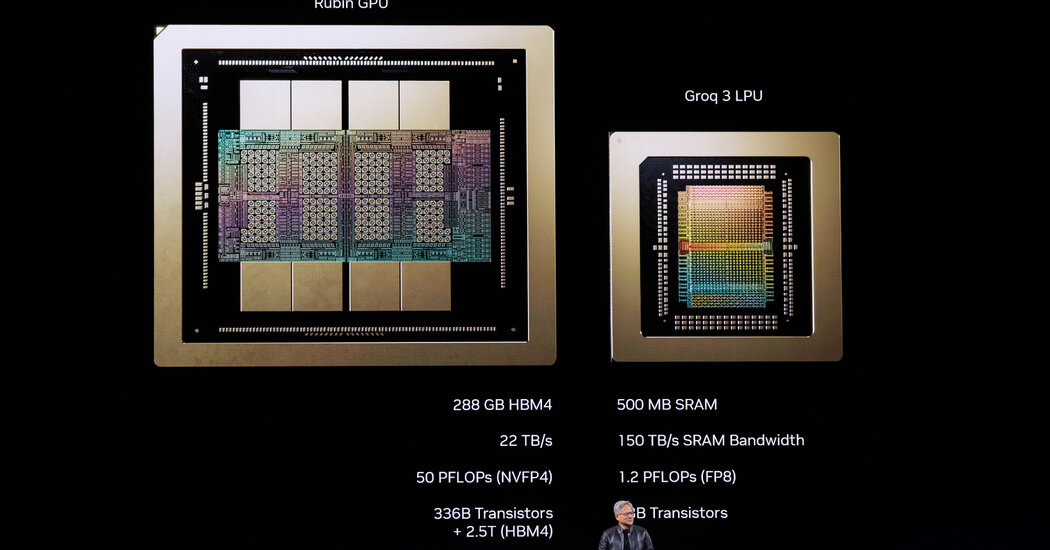
Groq described the deal at the time as a “nonexclusive licensing agreement” that gave Nvidia access to Groq’s chips, which are custom-built for running A.I. As part of the arrangement, Groq’s chief executive, Jonathan Ross, and its chief operating officer, Sunny Madra, joined Nvidia.
A.I. companies have struck numerous deals that involve licensing technology and hiring top employees from other companies without completing an outright acquisition. But those arrangements often evade automatic government reviews — common for traditional mergers and acquisitions — that determine whether a deal would harm competition.
Government officials have considered whether these deals should receive more scrutiny while they grapple with the way a small number of companies have consolidated power over A.I.
The Justice Department opened the investigation into the Groq deal shortly after it was announced in December and has sent Nvidia a formal demand for information about it, one of the people said. If the Justice Department does find fault with the way Nvidia handled the deal, the agency may fine the company, the two people said. It would probably not require the deal to be undone, they added.
The people, who requested anonymity because the process is confidential, cautioned that no outcome had yet been determined and that the Justice Department might ultimately find no wrongdoing.
A spokesman for Nvidia, John Rizzo, said in a statement: “The Groq story is a prime example of the American system working as designed to promote innovation, reward entrepreneurs and benefit consumers.” He added, “The law is designed to encourage America’s start-up ecosystem and promote the fundamental rights of inventors and workers to pursue their dreams.”
A spokeswoman for the Justice Department declined to comment “on any matters before the D.O.J.”
“However, we can affirm that this D.O.J. under President Trump’s leadership will continue to prioritize affordability for all Americans across our economy,” the spokeswoman said in a statement.
Andrew Ferguson, who leads the Federal Trade Commission, told Bloomberg in January the agency had begun to examine whether these kinds of deals were structured to avoid regulatory scrutiny. These deals have also come under scrutiny by Senate Democrats. Senators Elizabeth Warren of Massachusetts and Richard Blumenthal of Connecticut have called for the F.T.C. and the Justice Department to investigate some of the deals, including Nvidia’s partnership with Groq.
The deals “function as de facto mergers, allowing the companies to consolidate talent, information and resources, all while apparently attempting to bypass the scrutiny typically applied to mergers and acquisitions,” the senators wrote in a letter to the F.T.C. and Justice Department this year.
While some of these deals siphon critical resources away from companies and effectively render them shells of their former selves, others continue to operate and grow. Groq, for example, still sells cloud computing services, and in August announced it was raising $350 million in a funding round that Nvidia planned to participate in.
The Justice Department’s scrutiny comes as Nvidia, which has a market capitalization of $5.4 trillion, has effectively become Silicon Valley’s central banker, using its vast financial resources to bolster A.I. start-ups and funnel money to customers.
As Nvidia has become the anchor of the artificial intelligence boom, its chief executive, Jensen Huang, has developed a close relationship with President Trump.
Mr. Trump, who took Mr. Huang to a summit with China’s leader in May, has called Mr. Huang “an incredible guy.” Mr. Huang has lauded Mr. Trump for dismantling regulations and encouraging investment in artificial intelligence.
Groq, which was founded in 2016, was last valued at $7 billion before its deal with Nvidia, according to PitchBook. Its investors include Samsung, BlackRock and 1789 Capital, which counts Donald Trump Jr., one of the president’s sons, as a partner.
Kalley Huang contributed reporting.
