
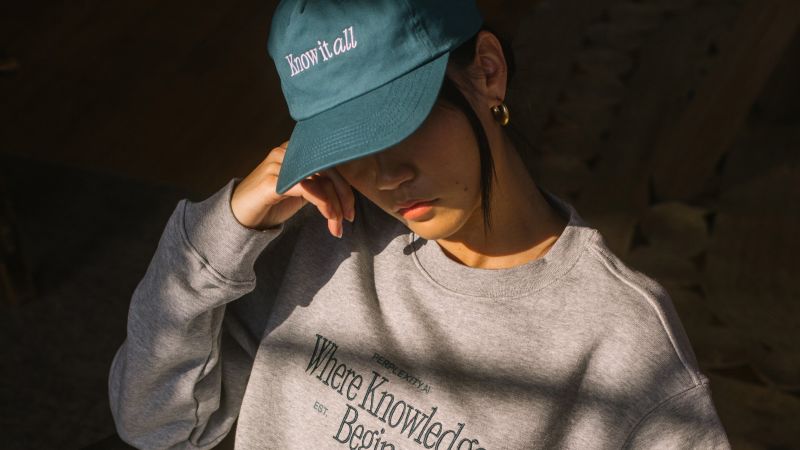
Unless you have a passionate opinion about your preferred artificial intelligence model, it’s likely the clothes that multi-billion dollar companies like OpenAI, Perplexity, Anthropic and Cohere are suddenly churning out aren’t meant for you. You likely aren’t going to be wearing Perplexity’s padded ecru jacket with a corduroy collar and a “Curious” fabric tag ($135) or Cohere’s “Stacking Stones” T-shirt ($41) with “The Material of Now” printed across the back. The same goes for OpenAI’s “Research” half-zip sweatshirt ($175), to say nothing of Palantir’s royal blue chore coat ($239). (Those are both sold out anyway.)
Tech industry types have gone all in. “Unfortunately cool as hell and I need it lol,” Rachel Tobac, CEO of the cybersecurity firm SocialProof Security, wrote on X after seeing OpenAI’s newest collection in July. “Good to see that tech merch isn’t boring anymore,” wrote Haimantika Mitra, a developer advocate at the cloud computing company Digital Ocean.
Ben King, a design director at OpenAI, said his team wanted to take cues from those boosters about exactly what they would be excited about in a piece of clothing. “We wanted to create cool, thoughtful items that reflect our product while also engaging with our own community and seeing what they’re wearing,” he said. Most of the clothing King saw on those people were the basic uniforms of the modern tech worker — T-shirts, sweatshirts, hats — so King, who has a background in designing streetwear, and his team set out to create the “best versions” possible. The merch was originally made for OpenAI employees to purchase on an internal site, but the team decided to make a small capsule collection available to the public. It sold out within days.
David-Alexandru Ilie, an intern at the tech company Vercel in London, bought two hats, a hoodie and a T-shirt for about $220 and, since he lives in the UK, paid more than $100 for shipping. He said the merch signals a certain level of affinity and expertise in the AI space. “When I’m wearing Codex-specific merch my goal is not to show that I’m a shill for OpenAI, but rather to show that I am a software engineer keeping up with current trends,” he said via email, referring to OpenAI’s code writing product. “Even though I’m not walking around Silicon Valley wearing this merch, I still like to feel like part of the software engineering community there.”
Rory Bernier, who runs a tech advisory firm in Connecticut, said wearing a hoodie he was sent from the Perplexity team as a gift gave him an air of “proximity” to a favorite company. “Wearing it is a low-key signal, both to myself and to other people in the space, that I’m not just watching the AI wave, I’m in it,” he said via email. In that way, it’s similar to wearing a your sport’s team jersey or a band T-shirt.
For those outside the echo chamber of tech, though, responses to the merch have been less charitable. “[M]y catholic school uniform had more aura,” the photographer and writer Gavin Moulton posted on X. “I think that tech needs to reckon with the fact that if you zoom outside of our little bubble, the idea of wearing clothes with software logos makes you a really big nerd,” posted the designer J.D. Reeves.


Critics have called the design references passé. OpenAI’s lookbook for their capsule collection is an apparent homage to tastemaking brands like Kith and Aimé Leon Dore, two labels that turned laidback knitwear and box cut T-shirts into trends that saturated menswear in the last few years. “The aimé leon dore lookbook from 2023 does it again,” posted the brand strategist Lorenzo Lasagna.
The debate may look like it’s about clothes, but is in fact part of a wider skirmish between people that stand to benefit from a world dominated by AI products and those threatened by it. Some of the loudest opposing voices are creatives, who see the products being created by AI companies as something threatening to their own practice and to the world at-large. “They’re wolves in sheep’s clothing attempting to create the feeling that a tech company with merch is harmless,” said the graphic designer David Rudnick. “It’s like wearing the colors of a cartel or a paramilitary organization.”

Naturally, those in the tech industry don’t see it that way. Rather than trying to appeal to everyone, designers creating this merch consider people like Ilie their target audience. One designer who worked on Perplexity’s merch but asked not to be named as they were not permitted to speak on behalf of the company said their work was similar to the ubiquitous and sometimes indiscernible billboards that line Highway 101, Silicon Valley’s commuter corridor in San Francisco. “Those billboards aren’t targeting everyday people,” the designer said. “They’re targeting their competition, they’re targeting potential employees.”
These products are meant to facilitate the evolution of AI giants into something softer. “More tech companies are going to evolve into lifestyle brands that will eventually become the end state,” said Joher Khan, the co-founder of Plumsoda, a design agency that, according to its website, creates merch that “turns tech companies into cultural icons.”
Through a more skeptical lens, Rudnick also said it helps to camouflage some of the more controversial aspects of AI companies. OpenAI and Anthropic have both worked with the Pentagon, and Anthropic recently reached a $1.5 billion settlement over a claim that the company illegally used copyrighted material to train its large language model. Anthropic did not admit to any wrongdoing, and said that using copyrighted books to train AI models was covered under fair use laws. CNN is currently suing Perplexity alleging unlawful copying and distribution of CNN’s content.
The merch trend suits a tech industry that has started to show more interest in cultural signifiers over the last few years. For a long time, the popular image of a Silicon Valley software engineer has been someone who eschews any interest in fashion because it signals that they care more about how they look than what they’re creating. Think about Steve Jobs and his black turtleneck. But now that the ability to write code has become somewhat democratized with AI tools, they’re looking for something else to differentiate themselves from the pack. “There was a philosophy of not burdening yourself with choice in order to optimize our time and our efficiency,” the Perplexity designer said. “I think that there’s a pendulum swinging the other way. Now that we’re all sort of using the same tools, opinions about cultural signifiers are the biggest lever.”

The problem is that AI’s outputs are derivative by nature, which makes it an open question whether or not the merch these companies are creating can only be a synthesis of references or actually point towards something novel or distinct.
“The clothing is just boring,” Jake Woolf, a menswear critic and writer, said. “I see the merch as the true spirit of what AI is in that it’s an amalgamation of different aesthetics smashed together to create something that is broadly appealing and inoffensive. But there’s no real point-of-view behind it.”
Andrew Chen, the co-founder of clothing brand 3sixteen, felt similarly. “The pieces are whatever. There’s nothing inherently offensive about any of these collections to me, except if you don’t really mess with AI,” he said. “The cut of the T-shirt is cool. The blue is nice. But I don’t think I’d rock a Codex T-shirt.” Chen said it was clear that the collection was more about brand marketing and positioning AI companies as something aspirational and cool. Even the limited production runs were intended to create a sense of, as Chen put it, “this stuff is for people who really, really like AI.”
King, of OpenAI, rejected the idea that because something is made by an AI company it lacks humanity. He said his team used AI tools during the initial sketching phase and while mocking certain things up, but that the design team is passionate about the humanity in their practice. “We love what we do. We take it seriously,” he said. “We’re always pushing ourselves to think more inventively and make sure the craft is done correctly.”
Big Style: Where culture meets clothing
- CNN senior style reporter and advanced outfit anthropologist Rachel Tashjian excavates the stylish amusements and contextualizes the world of fashion – all in your inbox. Sign up for Big Style here.
But there is a deeper question of why a modern tech company, especially an AI company, would need to soften their image with cotton and canvas. A recent Gallup poll found that more people think AI is bound to have a negative impact on society than a positive one. Young people in particular have soured on the technology over the last year, a development that may at least partially be explained by a pallid entry-level job market. Putting Palantir’s chore jacket aside for a moment — it seems more like a sartorial provocation given the company’s love of bombast and controversy; people wearing it seem to invite the minor shock of the logo — the ambition for companies like OpenAI and Perplexity to become beloved consumer brands like Apple or even Nike is practical and creating merch collections is part of that strategy.
Rudnick, the designer, doesn’t see it as such an innocent parallel. “The proposition is being put to the world where society and jobs are about to be swallowed by six or seven companies and that means your way of making a life will be eliminated by them,” he said. “Wearing the merch is a way that people feel like they’re protecting themselves, like they’re wearing the right colors of a feudal lord.” You have to want those colors in your closet in the first place, though, and it’s not clear that this merch is made for anyone but the true believers.
