Doomscrolling on an iPhone, firing endless questions at ChatGPT, or streaming a 4K film on Netflix on your laptop – behind these modern life conveniences lies a high-stakes contest between two Asian technology powers.
For decades, South Korea and Taiwan have been locked in a cut-throat battle for supremacy in the technologies that underpin the digital age, from televisions and smartphones to memory chips.
Now, that heated rivalry is turning into a once unthinkable partnership, as they race together to deliver the world’s most sought-after commodity: AI accelerators – the specialized hardware chips that process up to trillions of calculations at once to train generative models.
“We don’t have time to get into this old-fashioned conflict,” said Sung Soo Eric Kim, distinguished guest professor at Keio University in Tokyo. “There’s so much demand; we have to cooperate and supply first.”
Spurred by tech giants’ insatiable appetite for computing power to dominate frontier models, the unprecedented global expansion of AI infrastructure has created demand so enormous that no single country can satisfy it.
That has stretched thin the capacity of key suppliers of accelerators designed by industry leaders Nvidia and AMD, whose products count on the increasingly intertwined supply chain linking Taiwan and South Korea.
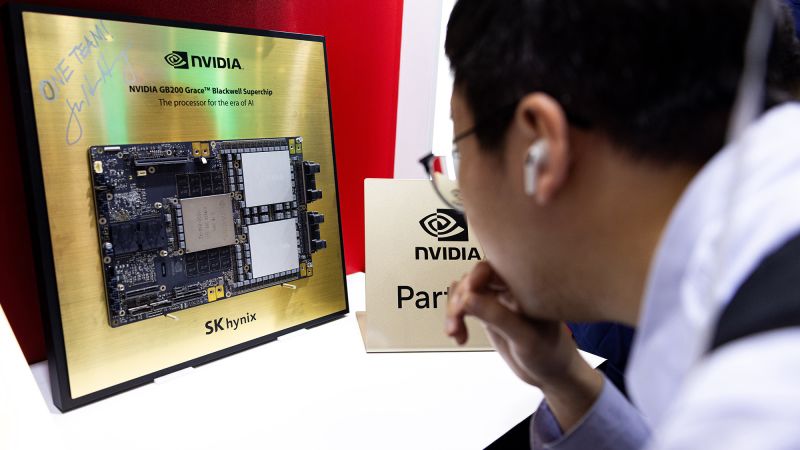
Highlighting the urgency of the strained supplies amid the AI boom, Nvidia CEO Jensen Huang scribbled a message on a piece of memory wafer from South Korean firm SK Hynix at Taipei’s annual computer show in June: “Please make more.”

The hundreds of thousands of AI servers that fill the cavernous halls of data centers from Virginia to Germany are a testament to the deep interdependence of the industry.
Building a single Nvidia AI server requires computing chips manufactured by Taiwan’s TSMC, memory chips supplied by South Korea’s SK Hynix or Samsung, and special technologies that combine them into AI accelerators. Taiwanese manufacturers then assemble these accelerators into server racks equipped with sophisticated cooling systems before they are deployed to power artificial intelligence.
“In the AI era, technological competitiveness alone is not enough and the ability to supply the required volume at the exact moment customers need it is the ultimate competitive advantage,” a spokesperson for SK Hynix told CNN, adding that the firm is accelerating plans to construct new factories.
This intricate partnership, though, was born less out of goodwill but necessity.

Relations between South Korea and Taiwan have long been defined by fierce competition, with the two sharing similar paths of industrial policy and economic development after World War II – as well as successfully transitioning from autocracies to vibrant democracies.
“Cooperation was actually very rare,” said Owen Lin, a veteran technology journalist and author of “Chip Champion: The Triumph of TSMC and Taiwan.” “Competition was much more common.”
Both former colonies of Japan, the two came to rely on exports to drive growth – first labor-intensive goods like garments in the 1960s, followed by electronics such as home appliances in the 1970s and ’80s.
Competition ratcheted up in the following decades as Asia became a manufacturing powerhouse for electronic components, ranging from screen panels for TVs and computer monitors to memory chips for personal computers. In consumer brands as well, Taiwanese computer makers Acer and Asus competed against Samsung and LG, while HTC challenged Samsung in smartphones.

But Taiwan was often at the losing end. South Korea surged ahead on the strength of its giant conglomerates like Samsung, which integrates multiple stages of the supply chain.
Illustrating the intensity of the rivalry, Taiwan’s Business Today magazine published a story in 2013, written by Lin, about executives at Samsung supposedly discussing a “Kill Taiwan” strategy in a 2008 internal meeting aimed at dominating industries where Taiwanese firms competed.
The firm rejected that such a strategy existed at the time and declined to comment when asked again by CNN.
Kim of Keio University cautioned against reading too much into the story, saying “all companies compete with each other.”
“They would, of course, have market strategies competing with not just Taiwan, Japan, and the United States – they’re a global company,” he said.
Even in the contract chipmaking sector that TSMC now dominates, Samsung initially had the upper hand.
The rise of iPhones turned Apple into a major buyer of semiconductors and Samsung, which also makes memory and display panels, was able to secure contracts to make iPhone processors exclusively until 2015. TSMC was then brought in by Apple, partly because of increasing competition with Samsung’s own smartphones, and later replaced Samsung to become its primary chip supplier.
TMSC’s success is, largely, thanks to Taiwan’s edge in customized contract manufacturing, which, Lin said, enabled its companies to build enduring partnerships with global technology firms.

CNN has reached out to TSMC for comment.
Unlike South Korea’s conglomerates that make everything, Taiwan’s electronic industries evolved into a dense ecosystem of specialized suppliers, each focused on a narrow piece of the manufacturing process.
“The work is split among perhaps a hundred different companies in Taiwan,” Lin said. “Each of those firms is relatively small, but they’re highly flexible and able to adapt quickly.”
In the era of AI, the advantage of Taiwan’s multifaceted ecosystem is on full display. Taiwanese companies now dominate niches from power supplies to chip packaging and cooling systems, allowing global customers to mix and match suppliers while keeping production flexible.
Taiwan’s grip on the AI supply chain is now larger than South Korea’s, said Jeong Woo Park, an economist covering South Korea and Taiwan at financial services firm Nomura, whose May report ranked Taiwan first in the world in capturing relevant AI hardware production.

AI-related exports helped push its economic growth to a 15-year high of 8.7% last year, and are estimated to supercharge the economy to a 11.05% expansion in 2026 – the fastest in 39 years, according to Taiwan’s statistics authorities.
The divergence has helped Taiwan pull ahead of South Korea in gross domestic product per capita in 2025 for the first time in more than two decades, a gap that is expected to widen further this year.
But rather than deepening the rivalry, the AI boom has pushed the two economies toward growing interdependence, as they occupy different links in the supply chain.
“Both countries are now increasingly complementary for each other,” Park said, adding that Taiwan’s dominance in contract chipmaking and South Korea’s stronghold in the memory market made them irreplaceable.
SK Hynix and Samsung together account for around 80% of the world’s production of High Bandwidth Memory (HBM), components enabling the rapid transmission and storage of data critical in AI chips.
These HBM chips would then be assembled with the computing chips TSMC produced through a technology known as advanced packaging in Taiwan, as a critical final step in the making of AI accelerators. Because of that, South Korea logged a record trade surplus with Taiwan last year.
“Taiwan has become Korea’s corridor to the United States,” said Colley Hwang, president of Taiwan-based tech media and research group DIGITIMES.

Hwang described the relationship as a “frenemy” dynamic – a bond powered by AI demand, layered atop decades of rivalry.
“There’s very little goodwill between them. Each side sees the other as a competitor, and that’s unlikely to change anytime soon,” he said.
One example came just two months ago, when a Korean official displayed Taiwan’s map and flag on a giant screen, describing it as a “rival nation,” as South Korea launched its ambitious $576 billion AI and semiconductor investment plan.
Still, the AI ecosystem is increasingly crossing borders as the technology advances.
“No country can do everything on its own,” said Yu-Ning Chu, policy analyst at Taiwan’s government-funded Research Institute for Democracy, Society and Emerging Technology.
But neither country can afford to be complacent in its lead in AI hardware, said Jeremy Chih-Cheng Chang, the institute’s executive director.
“Manufacturers of components and parts aren’t going to disappear,” Chang said. “Whoever can supply those components and integrate them most efficiently for customers are the players that will remain indispensable.”
