
New York
President Donald Trump’s handpicked central bank chief is conducting an experiment on the grandest of stages. Trump’s point man on the economy is getting in the way.
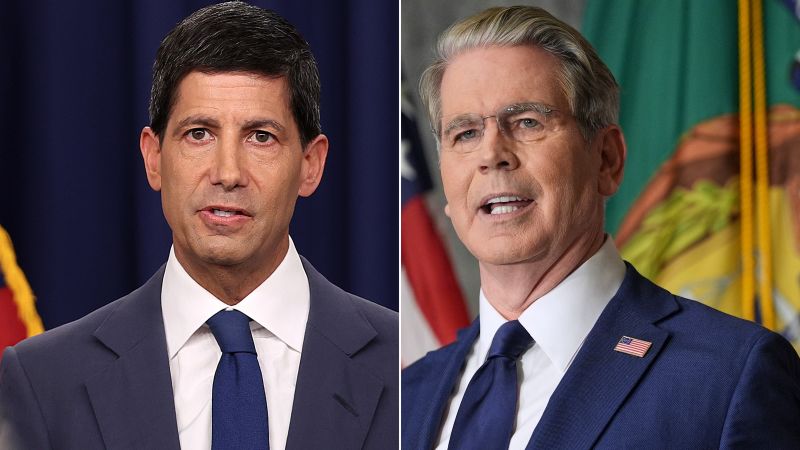
Federal Reserve Chair Kevin Warsh has stopped spoon feeding Wall Street clues on what the US central bank will do next.
His hope is that if the Fed ditches “forward guidance,” the bond market will stop trying to guess how the Fed is interpreting data releases and other factors and instead simply respond to the economic data itself. In theory, this untainted market response can then guide Fed officials debating whether to raise or lower rates.
That hands-off approach from Warsh was already facing perhaps insurmountable real-world obstacles because it’s almost impossible to get the market to stop obsessing over the next Fed move. And then Treasury Secretary Scott Bessent introduced a new wrinkle: a very hand-on approach in the Treasury market. His intervention in the bond market last week was widely viewed as an effort to put a lid on surging yields.
In other words, Bessent is fogging up the very same windshield Warsh was attempting to get a clear view from.
“If timing is everything in love, the bromance between Bessent and Warsh may be coming to an end,” said Tim Mahedy, a former San Francisco Fed official who is now CEO of research firm Access/Macro.
US Treasury rates – the same ones Warsh wants to use as a guidepost – dropped after Bessent announced a surprise plan last week to at least double Treasury buybacks.

“It’s not a clean signal of what the market wants if Treasury is intervening,” said Eric Rosengren, former president of the Federal Reserve Bank of Boston.
The Treasury Department presented the move as technical in nature, part of an effort to ensure liquidity in markets.
But analysts widely view the program as an attempt to drive down uncomfortably high bond rates, long a goal of Bessent’s. The 30-year recently climbed to the highest level since 2007, just before the Great Financial Crisis.
“There is no chaos in the Treasury market. The liquidity argument doesn’t hold,” Rosengren said. “It looks a lot more like window-dressing before the midterms.”
Legendary investor Stanley Druckenmiller, a mentor to Bessent, slammed the move as “artificial yield suppression” in an op-ed in The Wall Street Journal titled “Let the bond market speak.” (Druckenmiller was later criticized for using artificial intelligence to write the commentary).
Warsh has repeatedly lamented that inflation has been stuck above the Fed’s 2% target for the past five and a half years.
Fed officials this summer have debated whether to raise short-term rates as a result. At a minimum, Fed officials have agreed to hold rates steady.
But Bessent appears to be taking the opposite approach by attempting to engineer lower long-term rates. If he’s successful, that will drive down the cost of mortgages, business loans and the federal government’s own borrowing costs – all of which could stoke price pressures.
“The Fed and Treasury are working at cross purposes, which is not productive,” Rosengren said.
Warsh’s mum’s-the-word communication strategy has rattled markets accustomed to increased transparency at the Fed.
Under legendary Fed chief Alan Greenspan late last century, the US central bank offered few details about what it was doing.
But since the mid-2000s, the Fed has provided greater and greater guidance by holding press conferences, providing rate projections from policymakers and even agreeing to interviews of bank officials on “60 Minutes.”
“Taking back transparency will be really difficult to pull off smoothly,” said Benson Durham, a former Fed officials and founder of DASM LLC, an independent research firm. “It’s hard to put the genie back in the bottle.”
Warsh’s less-is-more style is a stark contrast to the more interventionist Bessent.
“You have a Fed chair who doesn’t say enough and a US Treasury secretary who says too much,” Durham said.
At the last Fed meeting in July, Warsh argued higher US Treasury rates are evidence that markets are learning to focus on the real data, not Fed speak.
“Market participants are learning to play the ball, not the referee,” Warsh said.
Fed watchers and economists are skeptical: Referees don’t take shots – but the Fed does.
It’s an active participant in markets, controlling short-term rates and influencing longer-term ones.
“The Fed is a fundamental part of the game. His analogy makes no sense. It completely ignores how things actually work – and that’s dangerous,” said Mahedy, the former San Francisco Fed official.
Not only that, but it’s almost impossible to get an unfiltered signal from the market. Investors don’t simply buy stocks after a bad jobs report or sell them on a hot inflation reading. They position themselves at least in part based on what they believe the data means for Fed policy.
That’s why sometimes stocks sell off after a blockbuster jobs report. It’s not that traders hate low unemployment, they’re just worried it will cancel the interest rate hope they were hoping for.
“The problem with this approach (from Warsh) is that participants in short-term interest rate markets – where Fed communication matters most – price what they think the Fed will do, not what it should do,” Goldman Sachs economist Jan Hatzius wrote in a note earlier this month.
Hatzius cautioned that providing less information will just make markets “more error-prone” and introduce “unnecessary volatility.”
When markets are uncertain about how central bankers will respond to incoming data, speculation can fill the void, according to a Barclays report last month.
“In such an environment, we find ourselves in a hall of mirrors: Market pricing can become less a reflection of economic fundamentals and more a reflection of what investors think policymakers are trying to signal,” Barclays economists wrote.
And Treasury’s intervention in bond markets threatens to make that hall of mirrors even more disorienting.
