
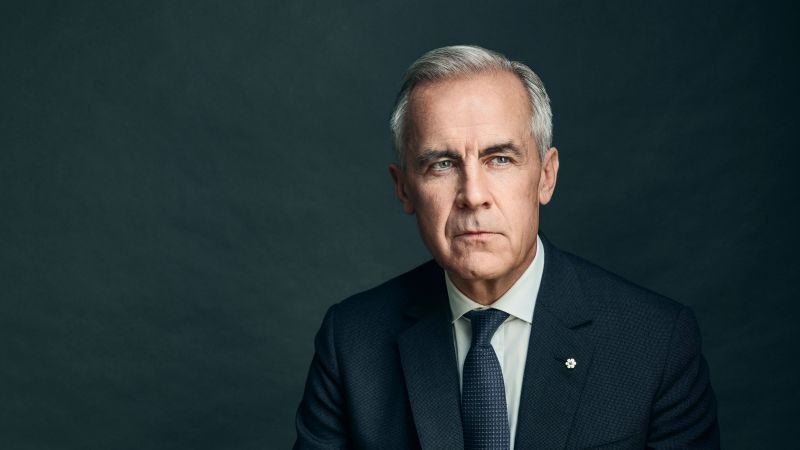
Mark Carney once provided the last line of defense for the Harvard Crimson hockey team.
As the back-up goalie — and often the back-up to the back-up — Carney spent most of each season on the bench. But teammate Mark Benning recalls one critical playoff game sometime in the mid-80s when Carney, sent onto the ice to replace an injured player, stopped all shots from the opposing team.
“I never saw any time where he cracked under pressure,” said Benning, a venture capital executive still friends with Carney.

Some 40 years later, now as Canada’s prime minister, Carney finds himself back in the rink, this time against the world’s most formidable opposition: President Donald Trump, flanked by the $30 trillion US economy.
On Saturday, Carney rejected a trade deal with the United States after Trump officials made 11th-hour demands that, among other outcomes, would’ve limited Canada’s freedom to cut deals with other nations. Red lines crossed, Carney vowed dollar-for-dollar tariffs on American goods entering Canada, some as high as 50%.
It was a bold move, one that echoed a speech Carney gave at Davos in January, in which he called on the world’s “middle powers” to band together against Trump and his tariffs. “If we’re not at the table, we’re on the menu,” he said of countries like his, cut adrift by a “rupture” in the rules-based global order.

Canadians overwhelmingly approved of his decision to walk away. Once again, now in the eyes of his country, Carney had met the moment.
Carney has forged his career through catastrophe. Once the top central banker for Canada and then Britain, he has shepherded economies through the 2008 financial crisis and its aftermath.
Still, his transformation from policy wonk to prime minister in last year’s election owes much to the 47th president. Trump’s tariffs and repeated taunts undermining Canadian sovereignty created a political crisis voters trusted Carney to best manage.
But the same fight behind Carney’s political strength may become his undoing. A protracted conflict with Canada’s closest and most powerful trading partner would put Carney in a bind. If he holds firm, he risks deep harm to the Canadian economy. If he makes concessions, he risks losing the support of an infuriated public.
Carney, today celebrated in a moment of crisis, could end up pleasing no one.
‘Calm’ but ‘demanding’
In the days before Carney walked away from the trade talks, Howard Lunick, Trump’s commerce secretary, had been texting and calling. The direct line of communication was nothing new and Lutnick’s agency had jurisdiction over the issues at hand. Even so, his last-minute entrance into talks between American and Canadian trade teams was disruptive, according to two people familiar with the matter.
Lutnick is more friendly and less bombastic with Carney in private than his public persona might suggest, one person said. Still, Lutnick strongly opposed provisions in the developing agreement that would have substantially lowered US tariffs on Canadian steel, aluminum and auto imports.
It was one backtrack of several that Carney said in a Saturday speech were “uneconomic, unfair, and undermined the net benefits for Canada, and called into question the reliability of any deal.”
Trump officials have rebuked Carney in the days since. Lutnick on Thursday rejected Canadian accounts of how talks had blown up, claiming Carney had “manufactured” a dispute to boost his domestic political standing. White House trade adviser Peter Navarro on Wednesday called the prime minister’s Trump-focused election victory last year the “worst thing that ever happened to Canada,” adding on CSPAN that “somehow, every time Carney dumps on Trump, the Canadian people reward him with political support.”

On Thursday, Trump signed an executive order renaming Lake Ontario to Lake America for US federal entities and saying, without mentioning Carney specifically, “The Canadian officials have treated us very badly. They’re nasty people.” He added that Canada is the “worst to deal with on trade,” claiming “they feel entitled.” Navarro warned Wednesday that “playing politics” with the US is “not going to end well for Canada.”
But Carney has handled greater emergencies. After Harvard, an economics Ph.D. at Oxford and more than a decade spent at Goldman Sachs, he moved into government in the run-up to the global financial crisis.
“Mark has always had the ability to see where an issue is going, understand the second- and third-order consequences,” said Tim Adams, a former US Treasury official during the George W. Bush administration, who often found himself in the same room as Carney. “He tends to be very prepared, very disciplined, and very comfortable operating under pressure.”
When the meltdown arrived in 2008, Carney was leading the Bank of Canada. James Moore, part of the country’s ruling Conservative government at the time and later its minister of industry, recalls an emergency cabinet meeting attended by Carney in the fall of that year. It was a time of pure havoc: Canada had just held a federal election and the global economy was beginning to buckle. Moore described Carney’s briefing that day as a “masterclass” — “blunt, calm, reassuring, and substantive.”
Carney now leads Canada’s Liberal Party, but Moore said he and other former members of that Conservative government “hold him in incredibly high regard and think that he’s doing a phenomenal job as Canada’s prime minister in these difficult times.”

The Bank of England poached Carney a few years later, appointing him the first foreign governor in the institution’s 330-year history. He helped steer Britain through the tumult of Brexit, appearing quickly after the 2016 vote to assure markets and citizens that he had a plan. He had warned openly of the economic risks, drawing criticism from pro-Brexit campaigners that he was veering too far into politics.
A report by Canadian magazine Maclean’s in October, citing an unnamed government staffer, painted Carney as short-tempered with some of his colleagues. The mood in Carney’s administration is tenser than that under his Liberal predecessor Justin Trudeau, who ran the place like “an encouraging teacher,” according to the publication.
Trudeau, the son of a Canadian prime minister, was familiar with the slings and arrows of politics. Carney, however, was more likely used to the deference that came from his position as the top finance guy, the steady hand in a complicated crisis, the magazine suggested.
“He’s demanding and is quite clear about what his standards would be, I think,” said Supriya Dwivedi, a former senior adviser to Trudeau who served with Carney on the advisory board for Canada 2020, a liberal think tank. “Because I think he’s such a hard worker himself, he kind of expects that of those around him – and there’s nothing wrong with that – but, of course, when you’re working very long hours and you’re in politics and not finance, you sometimes need a bit of a lighter touch.”
Carney’s tendency to arrogance was documented by Canadian newspaper The Globe and Mail in profiles that long preceded his political career. His capacity for snappiness was on public display during a press conference days after he became prime minister last year.
CBC correspondent Rosemary Barton told Carney it is “very difficult to believe” that his many years in the private sector had created no possible conflicts of interest with his finances. He seemed irritated.
“Look inside yourself, Rosemary,” he said, adding, “I have left my roles in the private sector at a time of crisis for our country. I’m complying with all the rules.”
Carney always risked seeming out of touch. His career in central banking was bookended by years spent in private investing, at Goldman and then Brookfield, a Canadian asset management firm where he worked up until his run for the Liberal leadership in early 2025.
Despite a background as the son of two teachers, born in a tiny town in the Northwest Territories and raised in Edmonton, Alberta, and now with a 30-plus-year marriage and four daughters, it would always be difficult for the Finance Guy to become the Everyman.
Pollster Nik Nanos tracked the 2025 election campaign. When the public concerns focused on the cost of living, the Conservatives under Pierre Poilievre would experience a boost, he told CNN. But then Trump would do something chaotic, outrageous or directly antagonistic to Canada — like calling it the “51st state” — and support for Carney’s incumbent Liberal Party would pop.

“In 2025, we came off 10 years of the Justin Trudeau Liberal government, and by the end of their tenure, people were ready for massive change,” said Nanos, chief data scientist of Nanos Research. But the focus quickly evolved. Suddenly, it wasn’t about “who you liked or what party that you liked — it turned into a ballot question on who can best manage the relationship with Donald Trump.”
Still, Canadians, though angry with the Trump administration, want a cooperative trading relationship with the US, according to Nanos. Carney’s real political test will come later, he said, when the economic consequences of tit-for-tat tariffs, like possible layoffs and business bankruptcies, become clear.
“It’s kind of like a classic war. You know, war is declared, everybody’s cheering as the soldiers go out the door, until the first soldier comes home as a casualty,” said Nanos.
And it’s possible Carney shares the same fate as other leaders valorized in conflict only to see their standing fall once the fight is over, the common enemy gone and polarizing domestic issues return to the top of the public agenda; for Canada, those include expensive housing and battles over immigration and health policy.
For now, though, Carney holds a commanding lead in Canadian opinion polls and is even winning some support on the other side of the border.
Debbie Dingell, a Democratic congresswoman from Michigan, has said she believes Carney is well within his rights to resist her president. “We are so integral to each other. It’s economic security, and it’s national security. They are our family. What President Trump is doing to Canada is just not OK. I’m fine that Carney is standing up,” she told CNN on Wednesday.
“There’s nothing popular about what President Trump is doing,” said Chellie Pingree, a Democratic congresswoman from Maine. Carney, Pingree said, was doing the “right thing, staying tough.”
On Thursday, Carney was put in the unusual position of standing up for the name of one of the Great Lakes. He noted on social media that the name of Lake Ontario is older than both Canada and the US, and he wrote, “We know that America is changing. Their trading relationships, their foreign policies, their national monuments, their hydronym. Canadians also know that naming reality means calling it Lake Ontario – then, now and always.”

In Toronto, retiree Diana Bartlett, 75, told CNN that she usually leans toward parties to the left of the Liberals and that she’s wary of Carney’s focus on business, saying he seems to have “forgotten a little bit” about critical social issues including health care.
Still, she picked Carney’s party in the last election — with the threat of Trump a key factor in her vote — and said she’s “fully supportive” of his decision to take a hard line with the president.
“I wish he had walked away a lot sooner. I’m getting really tired of being jerked (around) by Trump and his minions,” she said while grocery shopping Wednesday. “I’m a senior citizen, and I will take up arms to defend this country.”
CNN’s Phil Mattingly, Manu Raju, Ellis Kim and Jordan Budney contributed to this report.
